Skip to content
SEOHost.NET

SEOHost.NET

Most Diverse IP provider

  • Seo Hosting USA
  • A Class IP USA
  • Seo VPS USA
  • Dedicated Seo Server USA
  • Seo Hosting EU
  • A Class IP EU
  • Seo VPS EU
  • Seo Dedicated Server EU

Category: Web Hosting

  • How Much Does SEO Hosting Cost? A Transparent Pricing Breakdown

    How Much Does SEO Hosting Cost? A Transparent Pricing Breakdown

    • What You Are Actually Buying When You Pay an SEO Hosting Cost
      • The Scarcity That Sets the Floor
      • What Rides Along With Each Address
    • The Complete SEO Hosting Cost Grid, Published in Full
      • The Price Inversion Nobody Advertises
    • The 32-IP Rule: Where Your SEO Hosting Cost Flips
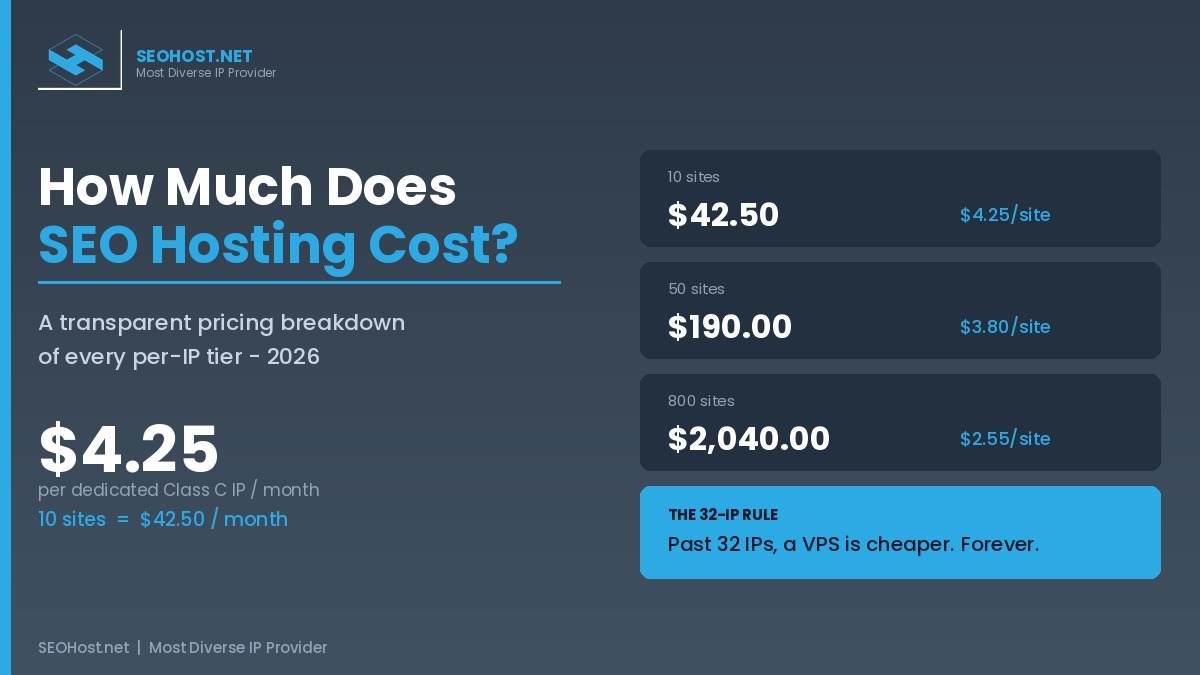
    • Worked SEO Hosting Cost at 10, 50, and 800 Sites
    • Geography as a Line Item: Why EU IPs Cost More
    • When the Server, Not the Address, Becomes the Cost
    • The Honest Part: What Your SEO Hosting Cost Does Not Buy
    • Calculate Your Own SEO Hosting Cost
    • A Practical Checklist Before You Pay Anything
    • Frequently Asked Questions: SEO Hosting Cost
      • How much does SEO hosting cost per month for a small business?
      • What is the difference between SEO hosting cost and SEO agency cost?
      • Why does the per-IP price fall when I move to an SEO VPS in 2026?
      • At what number of IPs does an SEO VPS become cheaper than shared SEO hosting?
      • How much does SEO hosting cost at SEOHost.net for a 50-site private blog network?
      • Is SEOHost.net cheaper than buying IPv4 addresses outright in 2026?
      • Does paying more for SEO hosting actually improve Google rankings?
      • Why do EU Class C IPs cost more than USA Class C IPs at SEOHost.net?
      • When is a dedicated server worth $299 versus an SEO VPS in 2026?
      • What hidden costs should I budget beyond the advertised seo hosting cost?
    TL;DR

    The seo hosting cost is $4.25 per IP monthly, so 10 sites run $42.50. Per-IP price falls with platform, not volume: past 32 IPs an SEO VPS is permanently cheaper than shared.

    Search for SEO hosting cost and you will be told the answer is somewhere between $1,500 and $5,000 a month. That number is real, and it is also completely wrong, because it describes something else entirely. Every result on that page prices SEO services — the agency retainer, the consultant, the content team. In fact, a poll of 439 SEO providers put the average retainer at $2,917 per month. Meanwhile, SEO hosting — the infrastructure that puts each of your sites on its own dedicated Class C IP address — starts at $4.25. Not per site per hour. Per IP, per month.

    Listen: what SEO hosting actually costs, and the 32-IP threshold most buyers cross without noticing. By Terry Cane, Chief Operating Officer, SEOHost.net.

    Consequently, this guide does the thing the pricing pages will not: it publishes the whole grid, runs the arithmetic at 10, 50, and 800 addresses, and shows you the exact point where the tier you are on stops being the cheap one. Furthermore, it names the number where that flip happens, because almost nobody notices when they cross it.

    What You Are Actually Buying When You Pay an SEO Hosting Cost

    Fundamentally, you are renting scarce addresses, not renting disk space. Specifically, an SEO hosting plan bills you per IP address because the IP address is the scarce thing; the storage attached to it is almost an afterthought. Therefore, understanding the price means understanding why a string of four numbers costs more than the server it points at.

    The Scarcity That Sets the Floor

    Notably, IPv4 addresses ran out. The registries that hand them out have exhausted their free pools, and RIPE NCC — the registry covering Europe — describes the result plainly as an acute shortage of unused IPv4 addresses affecting network operators worldwide. In practice, a new member can now request at most a single small allocation from whatever addresses get recovered, and the queue for that is long.

    As a result, addresses now trade on a secondary market. Historically, IPv4 addresses have sold in the range of roughly $11 to $32 each, having peaked considerably higher during the 2021 squeeze. Accordingly, when a host quotes you $4.25 a month for a dedicated Class C IP, that price is anchored to a genuinely scarce asset — which is why nobody in this market is giving addresses away, and why “unlimited IPs” is not a thing that exists.

    What Rides Along With Each Address

    Specifically, every IP on a USA Class C IP hosting plan arrives with 5 GB of storage and 50 GB of bandwidth attached. Furthermore, the account includes cPanel and WHM, the IP Manager plug-in for reassigning addresses to domains, private nameservers for each domain, free migration from any cPanel host, and daily and weekly backups. Consequently, the per-IP figure is not a base price waiting for add-ons — it is close to the whole bill.

    However, that 5 GB and 50 GB ceiling is a real constraint worth reading twice. In practice, it is generous for the small content sites these networks are usually built from, and tight for anything media-heavy. Therefore, if your sites are image or video heavy, the address is not your binding constraint and you should be reading the VPS section below rather than this one.

    The Complete SEO Hosting Cost Grid, Published in Full

    Notably, here is every per-IP tier SEOHost.net charges, in one table, with nothing withheld. Specifically, the reason this table is worth its own heading is that reading it top to bottom reveals something that contradicts how almost everyone shops for SEO hosting.

    PlatformIP quantity bandPrice per IP / monthPlatform fee
    Class A IP hosting (USA)5–12 addresses$8.50None
    Shared SEO hosting (EU)5–249 addresses$4.75None
    Shared SEO hosting (EU)250–500 addresses$4.25None
    Shared SEO hosting (USA)5–399 addresses$4.25None
    Shared SEO hosting (USA)400–800 addresses$3.75None
    Dedicated server (USA)5–399 addresses$4.25From $299/mo
    Dedicated server (USA)400–800 addresses$3.75From $299/mo
    SEO VPS (USA)5–799 addresses$3.00From $40/mo
    SEO VPS (USA)800–1,600 addresses$2.50From $40/mo

    The Price Inversion Nobody Advertises

    Specifically, the per-IP price does not fall as you buy more addresses. It falls as you change platform. Notably, the cheapest address in the entire grid — $2.50 — sits on the SEO VPS tier that most buyers assume is the expensive upgrade, and the VPS also carries the highest ceiling at 1,600 addresses. Meanwhile, the dedicated server, which costs $299 before a single IP is added, charges more per address than the VPS does.

    Consequently, the intuition that drives most purchasing decisions — buy more, pay less each — is only half true here. In practice, volume discounts within a tier are modest, moving you 50 cents at best. By contrast, changing tier moves you $1.25 to $1.75 per address, every month, on every address you own. Therefore, the platform choice is worth several times more than the volume negotiation, and it is the decision almost nobody deliberately makes.

    The 32-IP Rule: Where Your SEO Hosting Cost Flips

    Specifically, at 32 IP addresses, shared SEO hosting and an entry SEO VPS cost exactly the same: $136.00 per month. Furthermore, from 33 addresses upward the VPS is cheaper, and it never stops being cheaper. Accordingly, we call this the 32-IP Rule, and it is the single most useful number in this article.

    The arithmetic is not complicated. Shared hosting charges $4.25 per address with no platform fee. An entry SEO VPS charges $40 for the machine plus $3.00 per address. Therefore the VPS starts $40 behind and claws back $1.25 on every address, so it needs 32 addresses to draw level.

    Dedicated IPsShared SEO hostingEntry SEO VPSCheaper tier
    10$42.50$70.00Shared (by $27.50)
    20$85.00$100.00Shared (by $15.00)
    30$127.50$130.00Shared (by $2.50)
    32$136.00$136.00Identical — the flip point
    33$140.25$139.00VPS (by $1.25)
    50$212.50$190.00VPS (by $22.50)
    100$425.00$340.00VPS (by $85.00)
    400$1,500.00$1,240.00VPS (by $260.00)
    800$3,000.00$2,040.00VPS (by $960.00)

    Notably, look at the bottom row. At 800 addresses the gap is $960 every month — $11,520 a year — for identical address diversity from the identical pool. Consequently, an operator who scaled a shared plan from 10 sites to 800 sites without ever revisiting the tier decision has been overpaying by roughly the cost of a small car, annually, for a decision they made once and never questioned.

    Worked SEO Hosting Cost at 10, 50, and 800 Sites

    In practice, the number you actually care about is cost per site. Specifically, assuming the standard one-site-per-IP configuration that makes SEO hosting worth buying at all, here is what each network size costs and what each site inside it costs.

    Network sizeCheapest tierMonthly totalCost per siteAnnual total
    10 sitesShared SEO hosting$42.50$4.25$510.00
    50 sitesEntry SEO VPS$190.00$3.80$2,280.00
    800 sitesSEO VPS$2,040.00$2.55$24,480.00

    Interestingly, cost per site falls from $4.25 to $2.55 as the network grows — a 40 percent improvement — but almost none of that saving comes from the volume discount. Specifically, it comes from switching platform at the right moment. Therefore, an operator who stays on shared all the way to 800 sites pays $3.75 per site instead of $2.55, and pockets none of the improvement they think scale is earning them.

    Furthermore, note what happens at the 10-site end. Ten sites for $42.50 a month is less than a single hour of the average SEO consultant’s time. Consequently, for a small operator, the infrastructure is genuinely not the expensive part of SEO — which is worth remembering when a search engine tells you SEO costs $3,000 a month.

    Geography as a Line Item: Why EU IPs Cost More

    Specifically, European Class C addresses start at $4.75 against $4.25 for USA addresses — a 50-cent monthly premium per IP. In practice, that premium is regional scarcity showing up on your invoice rather than a marketing upcharge, because European address space is administered under RIPE NCC’s exhausted pool and its recovery-only waiting list.

    Consequently, buy European Class C IPs across Sweden, the UK, Germany and beyond when you are genuinely targeting European SERPs, and do not buy them for the sake of diversity alone. Notably, the EU pool covers 20 countries and 600 Class C addresses, so it is deep enough for real geo-targeting — but at 100 addresses the premium costs you $600 a year, which is only worth paying if the geography is doing work.

    When the Server, Not the Address, Becomes the Cost

    Notably, there is one case where the price grid stops being the right way to decide. Specifically, once your constraint is CPU, RAM, or bandwidth rather than address count, you are no longer buying IPs — you are buying a machine, and the addresses ride along.

    Accordingly, the bare-metal tier with 12 cores and 5 TB of bandwidth starts at $299 a month and charges $4.25 per address — more per IP than the VPS. Therefore, buying dedicated to get cheaper addresses is exactly backwards. Instead, three signals justify it: sustained concurrent load across the full domain set, workloads such as scraping or rank-tracking that need real hardware behind them, and root-level requirements a virtualized slice cannot satisfy. If none of those is true, the VPS is cheaper on every axis that matters.

    The Honest Part: What Your SEO Hosting Cost Does Not Buy

    Honestly, paying more does not rank you higher, and it never has. Specifically, Google treats a change of host or IP address as a routine infrastructure move rather than a ranking event, and there is no tier of hosting that functions as a ranking multiplier. Therefore, any provider implying that a pricier plan lifts positions is selling a story.

    Instead, what the money buys is separation and control: each site on its own Class C address, so that a network of interlinked properties does not present a single shared-server fingerprint to a crawler. Furthermore, that is a protective purchase, not a promotional one — a point our guide to which hosting model you actually need works through in detail, and one worth internalizing before you spend anything at all.

    Consequently, the correct strategy is the cheapest tier that delivers the separation you need — which is precisely why the 32-IP Rule matters more than any feature comparison. Additionally, because the same infrastructure independence governs whether AI answer engines can reach and cite your properties, the way diverse IP networks build AI authority is the other half of the same argument. Ultimately, if you are still unsure what the product category even covers, our older explainer on what SEO hosting actually is remains the right starting point.

    SEO Hosting Cost: Per-IP Price by Platform and the 32-IP Rule Chart comparing SEOHost.net per-IP pricing across Class A, EU shared, USA shared, dedicated server and SEO VPS tiers, and showing that an SEO VPS becomes cheaper than shared hosting above 32 IP addresses. SEOHOST.NET MOST DIVERSE IP PROVIDER SEO Hosting Cost, 2026 Per-IP price falls with PLATFORM – not with volume PRICE PER DEDICATED CLASS C IP / MONTH Class A $8.50 Shared EU $4.75 Shared USA $4.25 Dedicated $4.25 SEO VPS $2.50 cheapest + highest ceiling THE 32-IP RULE 32 IPs = $136.00 Shared and SEO VPS cost exactly the same. From 33 IPs, the VPS is cheaper forever. At 800 IPs the VPS saves $960 / month -> $11,520 / year COST PER SITE, ONE SITE PER IP 10 SITES $42.50/mo $4.25/site 50 SITES $190.00/mo $3.80/site 800 SITES $2,040.00/mo $2.55/site seohost.net | Verified from live pricing, July 2026

    Calculate Your Own SEO Hosting Cost

    Specifically, the calculator below prices your exact address count against every tier at once and names the cheapest. Furthermore, it flags whether you have crossed the 32-IP Rule, which is the answer most people come here for without knowing it.

    SEO Hosting Cost Calculator

    Drag to your dedicated Class C IP count. Every tier is priced from the live July 2026 grid.

    10 dedicated Class C IPs
    Shared SEO Hosting (USA)$4.25 per IP
    $42.50
    SEO VPS (USA)$40 platform + $3.00 per IP
    $70.00
    Dedicated Server (USA)$299 platform + $4.25 per IP
    $341.50
    See the live pricing

    A Practical Checklist Before You Pay Anything

    Ultimately, five questions decide your seo hosting cost, and they take about two minutes to answer honestly.

    • Count the addresses you will need in twelve months, not today. Because the 32-IP Rule is a threshold, buying for today’s count can put you on the wrong side of it within a quarter.
    • Check whether you have already crossed 32 IPs. If you are on shared hosting above 33 addresses, you are overpaying every single month, and the overpayment grows with every site you add.
    • Test your storage against the 5 GB and 50 GB per-IP ceiling. Media-heavy sites break this constraint long before the address count matters.
    • Buy EU addresses only if you are targeting EU SERPs. Otherwise the 50-cent premium per IP is diversity you are paying for and not using.
    • Escalate to dedicated only when resources, not addresses, are the constraint. Because the dedicated tier charges more per IP than the VPS, buying it for cheap addresses is a strictly worse deal.

    Finally, remember what the number actually is. Ten sites on fully dedicated Class C addresses cost $42.50 a month — less than one hour of an average SEO consultant’s time. Therefore, whatever is expensive about SEO in 2026, the infrastructure almost certainly is not it.

    Frequently Asked Questions: SEO Hosting Cost

    How much does SEO hosting cost per month for a small business?

    Specifically, a small business running 10 sites on dedicated Class C IPs pays $42.50 per month at SEOHost.net, because shared SEO hosting is billed at $4.25 per IP and each IP includes 5 GB of space and 50 GB of bandwidth. Notably, that is roughly one percent of what the same business would pay an SEO agency. The seo hosting cost tables further down break the figure out at 10, 50, and 800 IPs.

    What is the difference between SEO hosting cost and SEO agency cost?

    In practice, they are unrelated purchases that share a search term. Specifically, SEO hosting is infrastructure billed per IP address, starting at $4.25 per month, while SEO services are human labor billed as a retainer averaging $2,917 monthly. Consequently, a searcher comparing the two is comparing a server line item against a payroll line item.

    Why does the per-IP price fall when I move to an SEO VPS in 2026?

    Fundamentally, the per-IP price tracks the platform, not the quantity. Specifically, shared SEO hosting charges $4.25 per IP while an SEO VPS charges $3.00 and drops to $2.50 above 800 addresses, because a VPS assigns addresses to one tenant’s routing rather than administering them across a shared pool. Therefore, the cheapest per-IP rate sits on the tier most buyers assume is more expensive.

    At what number of IPs does an SEO VPS become cheaper than shared SEO hosting?

    Specifically, at 32 IPs. At exactly 32 addresses both tiers cost $136.00 per month, and from 33 IPs upward the SEO VPS is permanently cheaper. Furthermore, that crossover is what we call the 32-IP Rule, and the full break-even table appears in the pricing section above the calculator.

    How much does SEO hosting cost at SEOHost.net for a 50-site private blog network?

    Specifically, 50 dedicated Class C IPs cost $212.50 monthly on shared SEO hosting or $190.00 on an entry SEO VPS, which works out to $3.80 per site. Notably, 50 IPs sits past the 32-IP break-even, so the VPS is already the cheaper tier at this size. However, the interactive calculator below prices your exact address count.

    Is SEOHost.net cheaper than buying IPv4 addresses outright in 2026?

    Typically, yes, by a wide margin for anything under a few hundred addresses. Specifically, IPv4 addresses have traded at roughly $11 to $32 each on the transfer market, and the smallest routable block is a /24 of 256 addresses, so ownership means a five-figure purchase plus routing infrastructure. Accordingly, renting 10 IPs at $42.50 monthly is the rational choice until scale changes the arithmetic.

    Does paying more for SEO hosting actually improve Google rankings?

    Honestly, no, and any host promising otherwise is selling you something. Specifically, Google treats a hosting or IP change as a routine infrastructure move rather than a ranking event. Therefore, seo hosting cost buys footprint separation and operational control, not a ranking multiplier, which is precisely why the cheapest tier that meets your needs is the correct tier.

    Why do EU Class C IPs cost more than USA Class C IPs at SEOHost.net?

    Specifically, EU addresses start at $4.75 per IP against $4.25 in the USA, a 50-cent premium driven by regional scarcity. Notably, European address space is administered by RIPE NCC, whose free pool ran out and now issues at most a single small allocation from recovered space. Consequently, geography is a real line item in your seo hosting cost, not a marketing upcharge.

    When is a dedicated server worth $299 versus an SEO VPS in 2026?

    In practice, only when server resources rather than address count drive the decision. Specifically, the SEOHost.net dedicated tier starts at $299 monthly for 12 cores, 16 GB of RAM, and 5 TB of bandwidth, and its IPs cost $4.25 each, which is more than the VPS rate. Therefore, buying dedicated purely to get cheaper addresses is backwards, and the checklist below names the three signals that justify it.

    What hidden costs should I budget beyond the advertised seo hosting cost?

    Notably, three line items catch buyers out: the storage and bandwidth ceiling of 5 GB and 50 GB per IP, the platform fee on VPS and dedicated tiers that shared hosting does not carry, and the address count you actually need rather than the count you have today. Furthermore, SEOHost.net includes cPanel and WHM, IP Manager, private nameservers, and migration at no extra charge, which are commonly billed separately elsewhere.

    July 14, 2026
  • SEO Hosting vs PBN Hosting: Which Do You Actually Need?

    SEO Hosting vs PBN Hosting: Which Do You Actually Need?

    • What "SEO Hosting" and "PBN Hosting" Actually Mean (And Why People Confuse Them)
      • The Footprint Problem Both Models Try to Solve
    • The Two Models Behind the Labels
      • Model One: The Distributed-Cloud PBN Network
      • Model Two: The Dedicated Class C cPanel Server
    • The Control Tradeoff: The Real Decision You're Making
    • SEO Hosting vs PBN Hosting: The Model Matrix
    • When Distributed-Cloud PBN Hosting Is the Right Call
    • When Dedicated Class C + cPanel Is the Right Call
    • Which Model Do You Actually Need?
    • A Practical Checklist: Matching the Model to Your Project
    • Frequently Asked Questions: SEO Hosting vs PBN Hosting
      • What is the difference between SEO hosting vs PBN hosting?
      • Is SEO hosting vs PBN hosting a meaningful distinction in 2026?
      • Which is better for a private blog network, SEO hosting or PBN hosting?
      • Does SEOHost.net offer dedicated Class C IPs with a real control panel?
      • In SEO hosting vs PBN hosting, when should I choose the distributed-cloud model?
      • When does SEOHost.net's dedicated Class C cPanel hosting beat a managed PBN cloud in 2026?
      • What is the Control Tradeoff in SEO hosting vs PBN hosting?
      • How does SEOHost.net's IP model differ from distributed-cloud PBN hosting?
      • Can PBN hosting handle non-WordPress sites and scraping servers in 2026?
      • Does SEO hosting vs PBN hosting affect getting cited by AI search engines?
    TL;DR

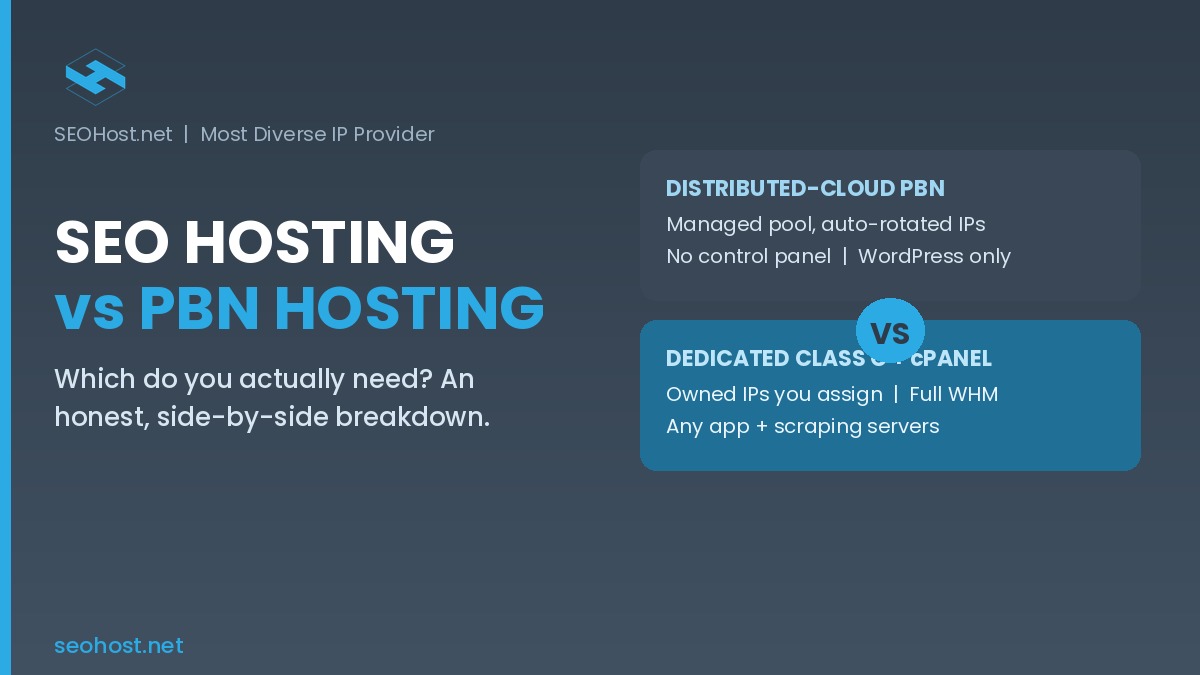
    The choice in SEO hosting vs PBN hosting is really a choice about control: dedicated Class C IPs on cPanel/WHM give you owned, transparent infrastructure, while distributed-cloud PBN hosting trades that control for hands-off convenience.

    If you have shopped for hosting to run a network of sites, you have hit the same wall everyone does: the term SEO hosting vs PBN hosting seems to describe two different products, yet the sales pages blur together. Furthermore, each vendor insists its own approach is the only serious option. The confusion is not accidental. Most providers sell exactly one model, so they frame that model as the answer rather than as a tradeoff. This guide separates the labels from the underlying architecture and gives you an honest, side-by-side way to decide.

    Listen: the two hosting models and how to choose between them. By Terry Cane, Chief Operating Officer, SEOHost.net.

    Specifically, there are two real engineering models hiding behind the marketing, and the SEO hosting vs PBN hosting debate is almost always a debate between them. Once you can see the two models clearly, the decision stops being about which vendor shouts loudest and starts being about what your project actually needs.

    What “SEO Hosting” and “PBN Hosting” Actually Mean (And Why People Confuse Them)

    In short, both terms describe hosting designed to make a portfolio of related sites look independent to search engines. The difference is in the wording, not the goal. “SEO hosting” is the older, broader term for hosting that assigns each site its own dedicated IP address, historically to diversify the network footprint. “PBN hosting” is the newer, narrower term that grew up around private blog networks, where the priority is hiding any connection between the sites entirely.

    Notably, the reason people confuse the two is that the marketing has collapsed the distinction. A provider selling dedicated Class C IPs will call it SEO hosting; a provider selling a managed, hands-off network will call the same underlying idea PBN hosting. Even Easy Blog Networks states out right that the terms SEO hosting and PBN hosting are used interchangeably, while arguing its own approach is better understood as PBN hosting. As a result, buyers assume they are comparing two categories when they are really comparing two delivery models for one goal. To learn how the older label was originally defined, our explainer on what exactly SEO hosting is lays out the Class C IP foundation in detail.

    The Footprint Problem Both Models Try to Solve

    Fundamentally, both models exist to solve the “footprint” problem. When many related sites share one IP address, one set of nameservers, and one registrar, a search engine can trivially connect them. That shared fingerprint is what devalues an interlinked network. It is worth being honest here about what Google says: its Search Advocate John Mueller has stated plainly that there is no SEO advantage to a dedicated IP and that shared hosting is fine for ordinary sites. The footprint concern is specific to interlinked networks built for link equity, not to standalone websites. Consequently, the entire point of specialized hosting, whether you call it SEO hosting or PBN hosting, is to break that network fingerprint into pieces that look unrelated. The two models simply break it differently, which is exactly where the real decision lives.

    The Two Models Behind the Labels

    Practically, once you strip away the branding, every provider in this niche is selling one of two architectures. Understanding both is the whole game, because the SEO hosting vs PBN hosting question is answered the moment you know which architecture your project needs.

    Model One: The Distributed-Cloud PBN Network

    Typically, the distributed-cloud model spreads your sites across a large pool of third-party infrastructure that the provider manages for you. A well-known example, Easy Blog Networks, publishes the exact providers it uses: roughly 21 upstream hosting providers and 4 separate DNS providers, reaching up to 500 IP addresses spread over 100-plus data centers. Moreover, the platform rotates and manages those IPs automatically, so you never assign or even see the individual addresses. The pitch is convenience: you add a site, the system places it somewhere in the cloud, and the network looks diverse without any work from you.

    However, that convenience has a hard boundary. Because the infrastructure is abstracted away, you get no control panel, no root access, and typically WordPress-only support. In other words, you are renting placement in someone else’s managed cloud, and the abstraction that makes it easy is the same abstraction that limits what you can do.

    Model Two: The Dedicated Class C cPanel Server

    By contrast, the dedicated Class C model gives you a real server with real, owned IP addresses that you administer through cPanel and WHM. Each site can receive its own dedicated Class C IP, and you assign private nameservers per domain so no shared fingerprint ties the network together. Instead of hiding the infrastructure, this model hands it to you. As a result, you can host non-WordPress applications, run a scraping or rank-tracking server, and see exactly which IP every site uses.

    This is the model SEOHost.net is built around, and it is worth being precise about what it includes. Its dedicated Class C IP hosting on cPanel/WHM ships with a custom WHM plugin that lets you change or assign a domain’s IP directly, private nameservers per site, and free migration from any existing cPanel/WHM host. The tradeoff is the mirror image of the cloud model: you get full control, but you are responsible for using it. To understand why this differs from ordinary shared hosting in the first place, our guide on why SEO hosting differs from regular hosting covers the IP-diversity fundamentals.

    The Control Tradeoff: The Real Decision You’re Making

    Here is the insight the vendors will not frame for you, because each sells only one side of it. Every option in the SEO hosting vs PBN hosting market sits somewhere on a single spectrum we call The Control Tradeoff. At one end is managed convenience: the provider hides the infrastructure, rotates the IPs, and asks nothing of you except a monthly payment. At the other end is owned control: you hold a control panel, you assign the IPs, and the network’s transparency is yours to manage.

    Crucially, neither end is “better” in the abstract. They are opposite answers to the same question: how much of the infrastructure do you want to touch? Distributed-cloud PBN hosting maximizes convenience by minimizing your control. Dedicated Class C hosting maximizes control by asking for your involvement. This is also why the SEO hosting vs PBN hosting decision should never be framed as a ranking shortcut: Google has repeatedly reaffirmed that a unique IP carries no inherent ranking benefit. Therefore, the decision is not a quality comparison at all. It is a self-assessment. The right question is never “which host is best?” but “where on The Control Tradeoff does this specific project need to sit?”

    Above all, this reframing matters because it explains why so many buyers feel misled after choosing. A set-and-forget operator who picks a dedicated server ends up overwhelmed by administration they did not want. Meanwhile, a builder who needs a scraping server or a non-WordPress stack picks a managed cloud and hits a wall the platform will never let them climb. Both bought a good product for the wrong position on the spectrum.

    SEO Hosting vs PBN Hosting: The Model Matrix

    To make the tradeoff concrete, the table below is the SEO Hosting vs PBN Hosting Model Matrix: a side-by-side of the two architectures across the six factors that actually change your decision. Notably, this is the comparison most vendors avoid publishing, because each sells only one of the two columns.

    The Control Tradeoff Spectrum A horizontal spectrum showing distributed-cloud PBN hosting at the managed-convenience end and dedicated Class C cPanel SEO hosting at the owned-control end, with the six decision factors between them. The Control Tradeoff Every SEO hosting vs PBN hosting option sits on one spectrum Managed convenience Distributed-cloud PBN Owned control Dedicated Class C + cPanel HIDES INFRASTRUCTURE – No control panel – Auto-rotated IP pool – WordPress only – Zero admin required HANDS YOU CONTROL – Full cPanel / WHM – Owned Class C IPs you assign – Any app + scraping servers – You administer it
    Decision factorDistributed-cloud PBN hostingDedicated Class C + cPanel (SEO hosting)
    IP modelProvider-managed pool, auto-rotated; up to ~500 IPs across 100+ data centersDedicated Class C IPs assigned per site; you see and control each one
    Control panelNone; proprietary dashboard onlyFull cPanel/WHM with custom IP-assignment plugin
    IP ownership and transparencyOpaque; provider owns and hides the addressesTransparent; owned addresses you assign yourself
    Footprint controlAutomated by the platform; hands-offYour responsibility; private nameservers per domain
    Non-WordPress and server workloadsWordPress-only; no root, no scraping serversAny application; scraping and rank-tracking servers supported
    Best-fit operatorSet-and-forget; never touches a serverHands-on; wants ownership and flexibility

    Read the matrix as a positioning tool, not a scorecard. Every row is a tradeoff, not a win. For instance, “automated footprint control” is a benefit if you never want to think about it and a limitation if you need to prove exactly which IP a site uses. That dual nature is the whole point of The Control Tradeoff.

    When Distributed-Cloud PBN Hosting Is the Right Call

    To be fair to the cloud model, it is genuinely the better answer for a specific operator. If every site in your network is WordPress, you never intend to open a control panel, and you value automatic IP diversity over ownership, the distributed-cloud approach removes real friction. In practice, it suits publishers who want to add a site and move on, treating the infrastructure as invisible plumbing.

    Additionally, the cloud model lowers the skill floor. You do not need to understand nameservers, DNS zones, or IP assignment to run a diverse-looking network, because the platform does all of it. For a solo operator with no server experience and a purely WordPress footprint, that is a legitimate advantage, and pretending otherwise would be dishonest. The moment your needs stay inside those boundaries, the convenience is real value rather than a hidden cost.

    When Dedicated Class C + cPanel Is the Right Call

    Conversely, the dedicated Class C model wins the moment your project needs anything the managed cloud abstracts away. First and foremost, if you want a real control panel to manage domains, email, databases, and DNS yourself, cPanel/WHM is non-negotiable, and the cloud model simply does not offer it. Similarly, if transparency matters, owned IPs you can see and assign beat a rotating pool you cannot inspect.

    Furthermore, this model is the only one that supports heavier, non-WordPress work. If you plan to run a dedicated server for scraping or rank tracking on owned Class C IPs, the managed cloud is a dead end, because it blocks server-level workloads by design. Growing operators also value the upgrade path: you can start on shared dedicated-IP hosting and move to an SEO VPS with root access and dedicated resources as concurrent load rises, all on the same control panel. That continuity is something a fixed managed platform cannot match.

    Finally, there is the AI-search dimension. Clean, owned, geographically diverse IPs give AI answer engines consistent signals to crawl and cite, which is harder to guarantee on a shared managed pool. Our companion guide on diverse IP networks and AI Overviews explains why infrastructure transparency is becoming an authority signal in its own right.

    Which Model Do You Actually Need?

    Rather than guess, answer four questions and let the pattern point you to a position on The Control Tradeoff. The interactive checker below walks through them and returns a recommendation you can act on.

    Which Model Do You Actually Need?

    Answer four questions. Your answers map to a position on The Control Tradeoff.

    1. Do you need a real control panel (cPanel/WHM) to manage sites yourself?

    2. Are all your sites WordPress, or do you need other applications?

    3. Do you need to see and assign each IP, or is an automated pool fine?

    4. Will you run a scraping, rank-tracking, or other server-level workload?

    See dedicated Class C plans

    A Practical Checklist: Matching the Model to Your Project

    Before you buy, run your project against this short checklist. Each item pushes you toward one end of The Control Tradeoff, and the side that collects the most checks is your model.

    • Do you want to log into cPanel/WHM and manage things yourself? That points to dedicated Class C hosting.
    • Are all sites WordPress with no plan to change? That tolerates the distributed-cloud model.
    • Do you need to prove or inspect exactly which IP each site uses? Owned Class C IPs are the only transparent answer.
    • Will you ever run a scraping server, rank tracker, or non-WordPress app? Only the dedicated model supports it.
    • Do you want zero server administration above all else? The managed cloud is built for that.
    • Do you expect to scale from a few sites to heavier concurrent load? A control panel with a VPS upgrade path protects that growth.

    Ultimately, if three or more items point to owned control, the managed cloud will eventually frustrate you, and starting on dedicated Class C hosting is the safer choice. If nearly everything points to convenience, the distributed-cloud model earns its keep. The labels never mattered; your position on the spectrum always did.

    Frequently Asked Questions: SEO Hosting vs PBN Hosting

    What is the difference between SEO hosting vs PBN hosting?

    Specifically, SEO hosting and PBN hosting describe the same goal reached two ways. SEO hosting means dedicated Class C IPs on a cPanel/WHM server you administer, while distributed-cloud PBN hosting means provider-managed IPs auto-rotated across many data centers with no control panel. The Model Matrix above maps every difference.

    Is SEO hosting vs PBN hosting a meaningful distinction in 2026?

    Yes, the SEO hosting vs PBN hosting distinction still matters in 2026, but it is a distinction of control, not quality. One model hands you a real control panel and IP ownership; the other hides the infrastructure for convenience. Your project decides which tradeoff fits, as the checklist above shows.

    Which is better for a private blog network, SEO hosting or PBN hosting?

    Notably, neither is universally better for a private blog network. Distributed-cloud PBN hosting wins on hands-off convenience across many data centers; a dedicated Class C model like SEOHost.net's cPanel/WHM hosting wins when you need a control panel, IP ownership, and non-WordPress sites. The Control Tradeoff section explains how to pick your side.

    Does SEOHost.net offer dedicated Class C IPs with a real control panel?

    Yes, SEOHost.net provides dedicated Class C IPs on cPanel/WHM with private nameservers you assign yourself. Furthermore, its custom WHM plugin lets you change or assign a domain's IP directly, and migrations from any cPanel/WHM host are handled free.

    In SEO hosting vs PBN hosting, when should I choose the distributed-cloud model?

    Choose the distributed-cloud PBN model when you run WordPress-only sites, want zero server administration, and value automatic IP rotation across many providers over hands-on control. This model suits set-and-forget operators who never touch a control panel.

    When does SEOHost.net's dedicated Class C cPanel hosting beat a managed PBN cloud in 2026?

    SEOHost.net's dedicated Class C cPanel hosting wins in 2026 when you need a real control panel, owned and transparent IPs, non-WordPress applications, or a scraping and rank-tracking server. In those cases the managed PBN cloud's convenience becomes a ceiling you cannot lift.

    What is the Control Tradeoff in SEO hosting vs PBN hosting?

    In practice, the Control Tradeoff is the single decision behind the labels: every model sits between managed convenience with hidden infrastructure and owned control with a full control panel. You are not buying better hosting; you are choosing where on that spectrum your project belongs.

    How does SEOHost.net's IP model differ from distributed-cloud PBN hosting?

    Typically, a distributed-cloud PBN host such as Easy Blog Networks spreads sites across many providers, reaching up to several hundred IPs across 100-plus data centers you never see. By contrast, SEOHost.net assigns dedicated Class C IPs you control directly through cPanel/WHM, so every address is owned and transparent rather than pooled.

    Can PBN hosting handle non-WordPress sites and scraping servers in 2026?

    Generally, distributed-cloud PBN platforms remain WordPress-only in 2026 and block server-level workloads. In contrast, dedicated Class C hosting on cPanel/WHM runs any application and supports scraping or rank-tracking servers on owned IPs, which is why heavier projects outgrow the managed cloud.

    Does SEO hosting vs PBN hosting affect getting cited by AI search engines?

    Increasingly, yes. Clean, owned, geographically diverse IPs give AI answer engines consistent trust signals to crawl and cite, which is harder to guarantee on a shared managed pool. This is the model SEOHost.net is built on, and our companion guide on diverse IP networks and AI Overviews covers the mechanism in depth.

    July 10, 2026
  • Three Reasons Why You Need Web Hosting

    Three Reasons Why You Need Web Hosting

    You’ve taken the first step to getting your business online. You’ve chosen and registered a great domain name. That’s awesome – now all you need to do is find a web host.

    (more…)
    April 5, 2019
  • Web Hosting For Students – Is It Worth It?

    Web Hosting For Students – Is It Worth It?

    LinkedIn. Facebook. Twitter. Instagram. There’s no shortage of opportunities for students and fresh graduates alike to establish their personal brand online.

    (more…)
    April 3, 2019
  • How To Change Web Hosting Providers – A Step-By-Step Guide

    How To Change Web Hosting Providers – A Step-By-Step Guide

    Sometimes, a web host isn’t quite what you expected. Maybe you’ve been hit with a ton of unexpected, hidden fees. Maybe the level of performance they promised isn’t quite what they delivered. Maybe getting in touch with their customer support team is like pulling teeth.

    (more…)
    March 5, 2019
  • What Exactly IS SEO Hosting, Anyway?

    What Exactly IS SEO Hosting, Anyway?

    Content might be king, but search engine optimization is still incredibly important in this day and age. Ensuring search engines such as Google can find and crawl your website – and that they’re able to easily categorize what your site contains -remains essential if you’re going to maximize your chances on the highly-competitive modern web. It’s not surprising, then, that many hosts offer what’s known as SEO Hosting.

    (more…)
    January 11, 2019
  • Why SEO Hosting Different Than Regular Hosting?

    Why SEO Hosting Different Than Regular Hosting?

    An old school hosting is no more good for your seo effort!

    Are you still hosting your most important websites on regular hosting company ? You may change your mind after watching this video below!

    https://www.seohost.net/blog/wp-content/uploads/2016/05/seohost.mp4

    (more…)

    May 10, 2016
SEOHost.NET

SEOHost.NET

Most Diverse IP Provider

  • Buy Domain
  • SSL
  • Why US
  • Blog
  • Affiliate
  • Contact Us
  • Support
  • Client Portal
  • F.A.Q.
  • Knowledgebase

Copyright © All Rights Reserved | SEOHost.net