
Skip to content
SEOHost.NET

SEOHost.NET

Most Diverse IP provider

  • Seo Hosting USA
  • A Class IP USA
  • Seo VPS USA
  • Dedicated Seo Server USA
  • Seo Hosting EU
  • A Class IP EU
  • Seo VPS EU
  • Seo Dedicated Server EU

Tag: seo hosting

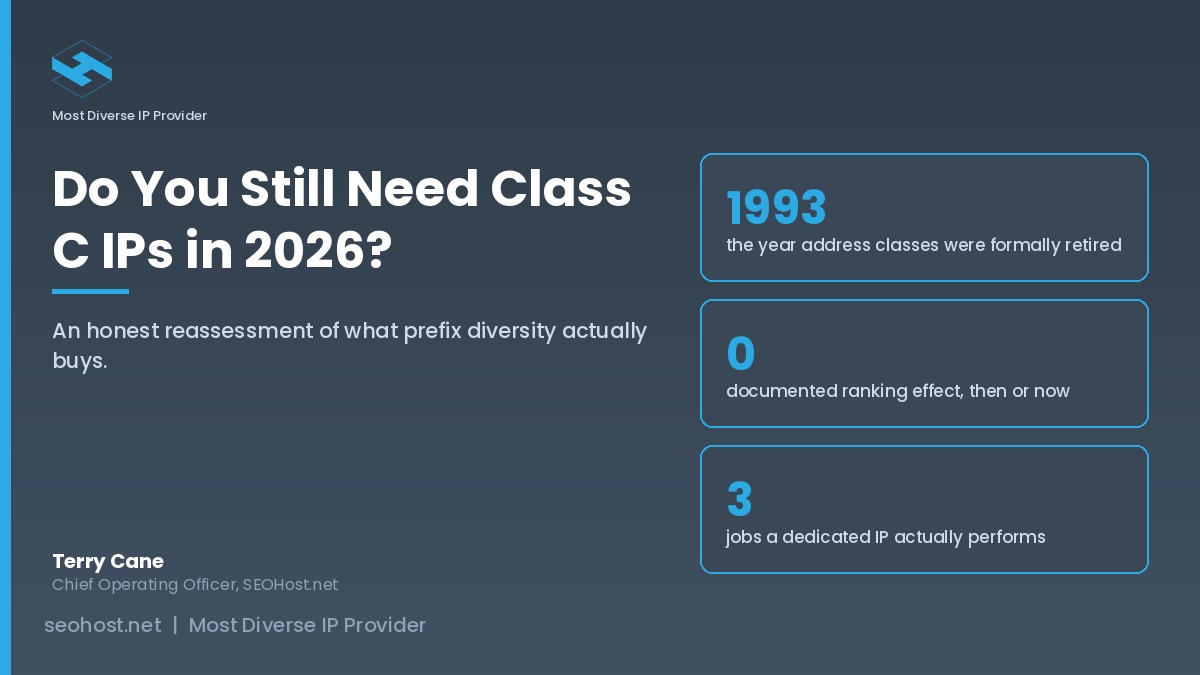
  • Do You Still Need Class C IPs in 2026? An Honest Reassessment

    Do You Still Need Class C IPs in 2026? An Honest Reassessment

    • Class C IP SEO in 2026: The Short Answer
    • What a "Class C IP" Actually Is (And Why the Term Retired in 1993)
      • Classless Routing Replaced Address Classes
      • What You Are Really Buying Is a /24 Prefix
    • The Class C IP SEO Ranking Claim: What Google Actually Documents
    • Job One — Footprint Separation: Class C IP SEO's Original Purpose
    • Job Two — Neighbor Risk and Reputation Containment
    • Job Three — Reachability: What Changed for Class C IP SEO in the AI Era
    • The Class C Reassessment Matrix (2026)
    • Class C IP SEO vs Dedicated IP vs Shared IP: Which Risk Are You Buying Down?
    • Class C Reality Check
    • When Class C IP Diversity Is Still Worth Paying For
      • Match the Tier to the Constraint, Not the Address Count
    • Frequently Asked Questions About Class C IP SEO
      • Does Class C IP SEO still work as a ranking tactic in 2026?
      • Class C IP SEO versus a single dedicated IP: which actually reduces risk?
      • Is the phrase Class C IP still technically accurate in 2026?
      • What are the three jobs of a dedicated IP that SEOHost.net identifies?
      • If I run 40 interlinked sites on one /24 prefix, does Class C IP SEO separation help?
      • How does shared IP hosting compare to SEOHost.net's Class C IP SEO hosting for blocklist exposure?
      • Does a dedicated IP address improve SEO rankings in Google?
      • How many distinct /24 prefixes exist in the historic Class C address space?
      • When should a 12-site network move from SEOHost.net shared Class C hosting to an SEO VPS?
      • Do AI search engines like ChatGPT use Class C IP SEO signals in 2026?
    TL;DR

    Class C IP SEO is not a ranking factor and never was. In 2026 it remains a risk-management purchase: it contains reputation damage and protects reachability, which is what AI answer engines actually depend on.

    Class C IP SEO is one of the last pieces of hosting folklore still sold at scale, and the honest answer to whether you need it in 2026 is more interesting than either side of the usual argument. Vendors say it lifts rankings. Skeptics say it does nothing. Both are wrong, and the reason they are wrong is that they are arguing about the same three letters while describing entirely different products.

    Listen: the honest reassessment of Class C IP diversity, and the three jobs it still performs. By Terry Cane, Chief Operating Officer, SEOHost.net.

    Below is a reassessment written the way we would explain it to a customer on the phone: what the term actually means, what Google actually documents, what the separation genuinely does, and how the arrival of AI answer engines changed the value of one of those jobs without changing the others at all.

    Class C IP SEO in 2026: The Short Answer

    Specifically, dedicated Class C addressing does not raise rankings, has never been shown to raise rankings, and no 2026 development changed that. Anyone selling it as a ranking multiplier is selling a story.

    However, that is not the same as saying the purchase is worthless. Separation across distinct prefixes does three concrete things, none of which is ranking. It limits how far a single abuse event can spread across a portfolio. It gives you an address reputation you control rather than inherit. Furthermore, it protects the plain ability of a crawler or an answer engine to fetch your page, which is the precondition for every ranking and every citation you might earn.

    Therefore, the correct question is not whether Class C IP SEO works. The correct question is whether your setup activates any of those three jobs. For a single business website, it usually activates none of them and the money is better spent elsewhere. For a portfolio of thirty interlinked properties that also sends email, it activates all three.

    What a “Class C IP” Actually Is (And Why the Term Retired in 1993)

    Notably, the vocabulary the entire industry uses to sell this product was formally abandoned by the people who invented it more than thirty years ago. Understanding why is not pedantry — it reframes what you are buying.

    Classless Routing Replaced Address Classes

    Originally, IPv4 addresses were carved into fixed classes at octet boundaries. Class A took the first octet, Class B the first two, Class C the first three. Consequently, a “Class C network” meant a block of 256 addresses sharing the same first three octets.

    However, that scheme did not survive contact with the growing internet. Classless Inter-Domain Routing replaced it, and RFC 4632, the current Best Current Practice document for CIDR, discusses the class A/B/C system entirely in the past tense as a problem that needed solving. Address classes have not described how the internet routes traffic since the 1990s.

    Accordingly, when a host advertises a “Class C IP,” no router anywhere agrees with that description. The term persists purely as market vocabulary in one small corner of the hosting industry, which is worth knowing before you evaluate any claim built on top of it.

    What You Are Really Buying Is a /24 Prefix

    In practice, the product being sold is a /24 prefix: an address block where the first 24 bits are fixed and the last 8 vary. That is the same “first three octets match” idea, expressed in the notation networks actually use.

    Furthermore, once you write it that way the arithmetic becomes checkable, and the arithmetic is genuinely surprising. The full IPv4 space contains 16,777,216 distinct /24 prefixes. The historic Class C range alone — first octets 192 through 223 — contains 2,097,152 of them. Meanwhile, the largest commercial diverse-IP pools on the market, including our own 1,300-plus distinct ranges, amount to roughly six hundredths of one percent of that historic space.

    Consequently, the “look statistically unique to a crawler” argument collapses on inspection. With two million prefixes in play, any two randomly chosen hosting accounts already sit in different ones. Distinctiveness was never scarce. What is scarce — and what you are genuinely paying for — is knowing and controlling who else shares your specific prefix. That distinction is the whole reassessment in one sentence.

    The Class C IP SEO Ranking Claim: What Google Actually Documents

    Specifically, Google’s own documentation treats moving your site between hosting providers, IP addresses, or CDNs as a routine migration rather than a ranking event. The Search Central guide to changing hosting infrastructure is written entirely around operational continuity: update DNS, watch server logs, keep verification working. Nowhere does it describe an address as a quality signal.

    Moreover, the practical evidence points the same direction. Shared addressing is the default condition of the hosted web. Content delivery networks place thousands of unrelated businesses behind the same address ranges as a matter of design. Therefore, an address-based penalty would sweep up an enormous volume of ordinary sites for no useful gain, which is why no search engine has ever documented one.

    Notably, that same Google guide does contain one instruction that matters enormously for the rest of this article, and it has nothing to do with rankings: check that your firewall or denial-of-service protection does not block a crawler’s ability to reach your servers. Google’s stated concern about your infrastructure is access, not allocation. Hold onto that.

    In other words, the reassessment does not end with “Class C IP SEO does not work.” It ends with a corrected understanding of what the product was always doing.

    Job One — Footprint Separation: Class C IP SEO’s Original Purpose

    Historically, prefix diversity was bought so that a network of interlinked properties would not present one obvious shared-infrastructure fingerprint. That was the original job, and it is worth being precise about how much of it survives.

    Firstly, the honest limitation. Separation does not make a manipulative link pattern acceptable. Google’s spam policies define link schemes by the behavior — buying, exchanging, or building links at scale to pass ranking credit — and those definitions say nothing about addressing. Consequently, a link scheme spread across forty prefixes is still a link scheme. Any vendor implying that IP diversity confers compliance is describing a product that does not exist.

    Secondly, the part that does survive. Separation limits blast radius. When one property in a portfolio attracts an abuse complaint, a malware compromise, or a hosting suspension, the question that determines your exposure is how much else lives at the same address. Furthermore, that is an operational risk with an operational answer, and it is entirely independent of whether search engines look at IPs at all.

    Ultimately, Job One is real but conditional. It applies to portfolio operators and to nobody else. If you run one site, this job is inert, and our breakdown of which hosting model your project actually needs works through where the boundary sits.

    Job Two — Neighbor Risk and Reputation Containment

    Notably, this is the job most buyers underrate, and it is the one with the clearest published mechanism. Address reputation is real, it is tracked by third parties, and it propagates at range granularity rather than one address at a time.

    Specifically, the Spamhaus Blocklist lists both individual addresses and address ranges, and its published listing criteria include patterns rather than single events — snowshoe configurations across ranges, and providers that decline to disconnect abusive customers. Additionally, the Combined Spam Sources dataset alone typically carries between two and four million listings at any moment.

    Therefore, the practical exposure on a shared address is straightforward: your deliverability, and sometimes your reachability, is set by the worst-behaved account sharing it. You did not choose those neighbors, you cannot see them, and you cannot remove them. By contrast, a dedicated prefix makes that reputation yours alone — which is a smaller promise than “better rankings” and a far more defensible one.

    Fortunately, this job is also easy to test. If your sites send transactional or marketing email, Job Two is active for you today, regardless of what you believe about search engines.

    Job Three — Reachability: What Changed for Class C IP SEO in the AI Era

    Above all, this is the job that changed value in 2026, and the change is subtler than the marketing suggests. No answer engine reads your IP allocation. There is no evidence that any large language model weighs prefix diversity, and we would be inventing a mechanism if we claimed otherwise.

    Instead, what changed is the cost of being unreachable. Traditional crawlers queue, retry, and come back tomorrow. Answer engines increasingly fetch at the moment a person asks. OpenAI, for example, documents three separate user agents with distinct jobs — one for training, one for search indexing, and one that retrieves pages live in response to a user’s question — and publishes the address ranges each operates from.

    Consequently, a fetch that fails does not get retried into a citation. It simply produces an answer built from somebody else’s page. Meanwhile, the most common cause of those failed fetches is not a robots.txt rule at all — it is bot management, rate limiting, and reputation-driven filtering sitting between the crawler and your server, exactly the layer Google’s own migration guide warns you to check.

    Accordingly, the AI-era case for dedicated addressing is an availability case, not a ranking case. You are not buying a signal. You are buying a smaller chance that somebody else’s behavior makes your page unfetchable at the exact moment an answer engine goes looking for it. Our earlier analysis of how diverse IP networks build AI authority takes the visibility side of that argument further.

    The Class C Reassessment Matrix (2026)

    Specifically, here is every common claim about Class C addressing, scored against what can actually be documented. Notably, two of the five are false, one is obsolete terminology, and two are real but conditional.

    ClaimVerdictMechanismEvidence class
    “Class C IPs improve rankings”Never trueNo documented address-based ranking inputSearch engine documentation
    “Class C” describes real addressingObsoleteAddress classes retired by classless routingIETF Best Current Practice
    “Diversity makes a link network safe”FalseSpam policies judge link behavior, not addressesSearch engine documentation
    “Separation limits abuse blast radius”Still trueOne address, one shared fate for everything on itOperational / provider policy
    “Address reputation is inherited”Still trueBlocklists list individual addresses and rangesReputation-service listing criteria
    The Class C Reassessment Matrix (2026) — SEOHost.net

    Therefore, read the matrix as a spending guide. The two “still true” rows are the only ones you can responsibly buy against, and both of them describe containment rather than promotion.

    The Three Jobs of a Dedicated IP Three panels showing the only three functions a dedicated IP address performs in 2026: footprint separation limits abuse blast radius, reputation containment stops inherited blocklist damage, and reachability protects live fetches by crawlers and answer engines. A fourth crossed-out panel notes that ranking is not one of the jobs. The Three Jobs of a Dedicated IP Ranking is not one of them. JOB ONE Footprint separation Limits how far one abuse event spreads across a portfolio. JOB TWO Reputation containment Blocklists list addresses and ranges. Shared means inherited. JOB THREE Reachability Answer engines fetch live. A failed fetch is not retried into a citation. NOT A JOB: raising rankings. No search engine documents an address-based ranking input.

    Class C IP SEO vs Dedicated IP vs Shared IP: Which Risk Are You Buying Down?

    In practice, the three options are not a quality ladder. Instead, each one buys down a different risk, and paying for a risk you do not carry is the most common mistake in this market.

    SetupNeighbor exposureBlast radiusRanking effectFits
    Shared IPInherited from strangersEverything on the addressNoneOne low-risk site, no email
    Single dedicated IPYours aloneYour site onlyNoneOne business site that sends email
    Multiple /24 prefixesYours alone, per prefixOne prefix at a timeNonePortfolios of interlinked properties
    Risk profile by addressing model — SEOHost.net

    Notably, the ranking column is identical across all three rows, and that is the point. Furthermore, once ranking is off the table, the decision becomes an ordinary infrastructure question with an ordinary infrastructure answer. Our full breakdown of what each tier actually costs per IP prices every option against a real address count.

    Class C Reality Check

    Accordingly, the checker below tells you which of the three jobs your setup activates, and therefore whether prefix diversity is worth paying for.

    Class C Reality Check

    Five questions. Which of the three jobs applies to you?

    Answer the questions above

      Result updates as you change any answer.

      Compare every SEOHost.net plan

      When Class C IP Diversity Is Still Worth Paying For

      Ultimately, the reassessment produces a short and unglamorous buying rule. Prefix diversity is worth paying for when at least two of the three jobs are active, and it is worth skipping when none of them is.

      • You operate a portfolio rather than a single site, and those properties reference each other.
      • The domains send transactional or marketing email, which makes address reputation a live commercial exposure.
      • You have already been burned once by a block, a suspension, or a deliverability collapse you did not cause.
      • Losing one property to an abuse action must not be allowed to take the other twenty-nine with it.
      • You need to see and control which address each domain sits on, rather than trusting a provider’s opaque pool.

      Conversely, skip it if you run one website, send no email, and have never had an infrastructure incident. Furthermore, no amount of prefix diversity will improve that site’s position, and the budget is better spent on content and performance.

      Match the Tier to the Constraint, Not the Address Count

      Specifically, when the jobs do apply, the tier follows from the constraint rather than the address count. Entry-level portfolios sit comfortably on dedicated Class C IP hosting in the USA, geo-targeted campaigns run on European Class C IP hosting, maximum separation across distinct first-octet ranges comes from multiple Class A IP hosting, and root-level or resource-bound workloads move to an SEO VPS or a dedicated SEO server.

      Finally, a note on where the ground is still moving. Answer engines are changing how retrieval works faster than any of us can publish about it, and our coverage of how AI Mode reshaped the hosting decision tracks that shift. Notably, none of it has produced an address-based ranking signal, and we will say so plainly on the day it does.

      Frequently Asked Questions About Class C IP SEO

      Does Class C IP SEO still work as a ranking tactic in 2026?

      Specifically, no. Class C IP SEO has never been a documented ranking factor, and nothing in 2026 changed that. Google treats a change of host or IP address as routine infrastructure work rather than a ranking event. What separation still buys you is risk containment, which the Class C Reassessment Matrix scores claim by claim.

      Class C IP SEO versus a single dedicated IP: which actually reduces risk?

      Notably, a single dedicated IP removes your exposure to neighbors on that one address, while Class C IP SEO spreads sites across separate /24 prefixes so no single reputation event reaches all of them. In practice, one dedicated IP handles a single business site, and prefix spread only earns its cost once you operate a portfolio.

      Is the phrase Class C IP still technically accurate in 2026?

      Interestingly, it is not. Address classes were retired by classless routing, and RFC 4632 discusses the class A/B/C system purely as history. Consequently, what the industry sells as a Class C IP is a /24 prefix. The term survives as market vocabulary, not as networking.

      What are the three jobs of a dedicated IP that SEOHost.net identifies?

      Specifically, the three jobs are footprint separation, reputation containment, and reachability. Notably, ranking is not among them. Each job has a different trigger, and the decision checker in this guide tells you which ones your setup actually activates.

      If I run 40 interlinked sites on one /24 prefix, does Class C IP SEO separation help?

      Typically, yes, but not for the reason most buyers assume. Furthermore, separation reduces the blast radius when one property triggers an abuse action, and it does nothing to make an interlinking scheme compliant. Google’s spam policies judge the link pattern itself, not the addresses underneath it.

      How does shared IP hosting compare to SEOHost.net’s Class C IP SEO hosting for blocklist exposure?

      By contrast, shared IP hosting places your site behind an address whose reputation is set by everyone else on it. Spamhaus lists both individual addresses and ranges, so one persistent abuser can pull a whole block down with them. Dedicated prefixes make that exposure yours alone to manage.

      Does a dedicated IP address improve SEO rankings in Google?

      Specifically, no. A dedicated IP address does not improve rankings in Google Search, and Google documents host and IP changes as routine migrations. However, a dedicated address does protect the reachability that every ranking and citation depends on, which is a different and much more defensible claim.

      How many distinct /24 prefixes exist in the historic Class C address space?

      Specifically, the historic Class C range spans first octets 192 through 223, which contains 2,097,152 distinct /24 prefixes. Additionally, the full IPv4 space contains 16,777,216 of them. Therefore, even the largest commercial pool represents a fraction of one percent, which is exactly why distinctiveness was never the scarce resource.

      When should a 12-site network move from SEOHost.net shared Class C hosting to an SEO VPS?

      Typically, the trigger is resources rather than addresses. Furthermore, a 12-site network moves to an SEO VPS when the per-IP storage and bandwidth envelope on shared hosting stops fitting the sites, or when root access and non-WordPress applications enter the picture. Our per-tier cost breakdown works the crossover through in detail.

      Do AI search engines like ChatGPT use Class C IP SEO signals in 2026?

      Notably, there is no evidence that any answer engine weighs IP allocation. However, AI systems fetch pages live at answer time through documented crawlers, so a page that cannot be reached is a page that cannot be cited. Consequently, addressing matters to AI search through availability, never through allocation.
      July 29, 2026
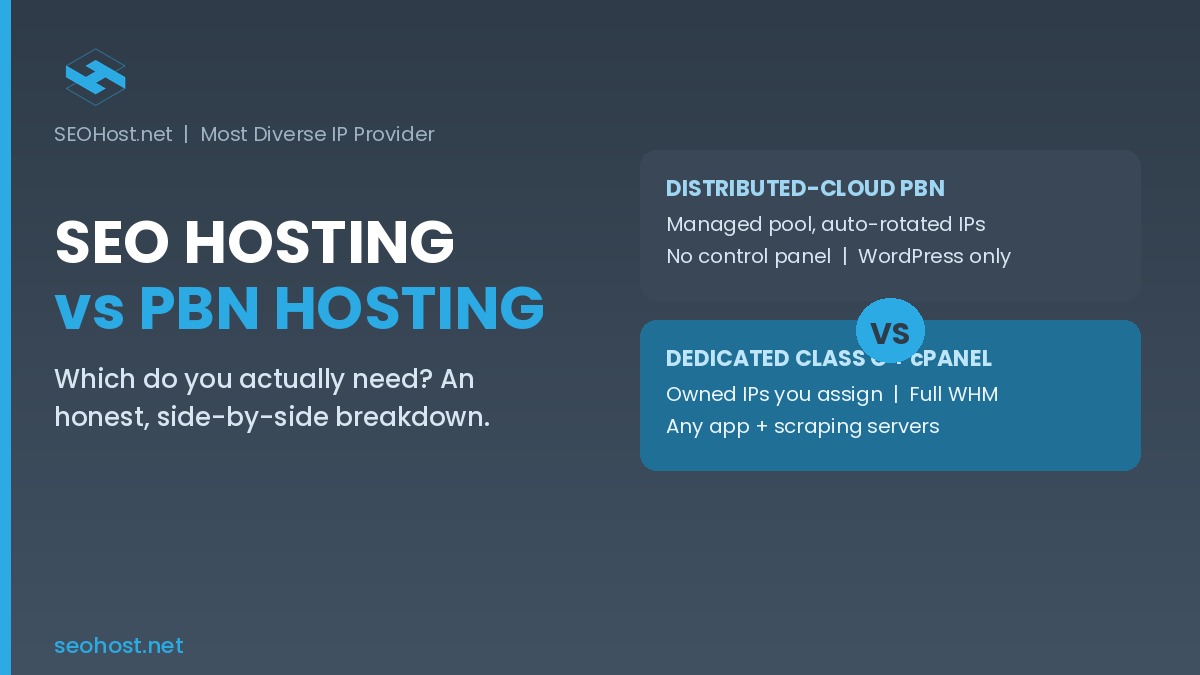
    • SEO Hosting vs PBN Hosting: Which Do You Actually Need?

      SEO Hosting vs PBN Hosting: Which Do You Actually Need?

      • What "SEO Hosting" and "PBN Hosting" Actually Mean (And Why People Confuse Them)
        • The Footprint Problem Both Models Try to Solve
      • The Two Models Behind the Labels
        • Model One: The Distributed-Cloud PBN Network
        • Model Two: The Dedicated Class C cPanel Server
      • The Control Tradeoff: The Real Decision You're Making
      • SEO Hosting vs PBN Hosting: The Model Matrix
      • When Distributed-Cloud PBN Hosting Is the Right Call
      • When Dedicated Class C + cPanel Is the Right Call
      • Which Model Do You Actually Need?
      • A Practical Checklist: Matching the Model to Your Project
      • Frequently Asked Questions: SEO Hosting vs PBN Hosting
        • What is the difference between SEO hosting vs PBN hosting?
        • Is SEO hosting vs PBN hosting a meaningful distinction in 2026?
        • Which is better for a private blog network, SEO hosting or PBN hosting?
        • Does SEOHost.net offer dedicated Class C IPs with a real control panel?
        • In SEO hosting vs PBN hosting, when should I choose the distributed-cloud model?
        • When does SEOHost.net's dedicated Class C cPanel hosting beat a managed PBN cloud in 2026?
        • What is the Control Tradeoff in SEO hosting vs PBN hosting?
        • How does SEOHost.net's IP model differ from distributed-cloud PBN hosting?
        • Can PBN hosting handle non-WordPress sites and scraping servers in 2026?
        • Does SEO hosting vs PBN hosting affect getting cited by AI search engines?
      TL;DR

      The choice in SEO hosting vs PBN hosting is really a choice about control: dedicated Class C IPs on cPanel/WHM give you owned, transparent infrastructure, while distributed-cloud PBN hosting trades that control for hands-off convenience.

      If you have shopped for hosting to run a network of sites, you have hit the same wall everyone does: the term SEO hosting vs PBN hosting seems to describe two different products, yet the sales pages blur together. Furthermore, each vendor insists its own approach is the only serious option. The confusion is not accidental. Most providers sell exactly one model, so they frame that model as the answer rather than as a tradeoff. This guide separates the labels from the underlying architecture and gives you an honest, side-by-side way to decide.

      Listen: the two hosting models and how to choose between them. By Terry Cane, Chief Operating Officer, SEOHost.net.

      Specifically, there are two real engineering models hiding behind the marketing, and the SEO hosting vs PBN hosting debate is almost always a debate between them. Once you can see the two models clearly, the decision stops being about which vendor shouts loudest and starts being about what your project actually needs.

      What “SEO Hosting” and “PBN Hosting” Actually Mean (And Why People Confuse Them)

      In short, both terms describe hosting designed to make a portfolio of related sites look independent to search engines. The difference is in the wording, not the goal. “SEO hosting” is the older, broader term for hosting that assigns each site its own dedicated IP address, historically to diversify the network footprint. “PBN hosting” is the newer, narrower term that grew up around private blog networks, where the priority is hiding any connection between the sites entirely.

      Notably, the reason people confuse the two is that the marketing has collapsed the distinction. A provider selling dedicated Class C IPs will call it SEO hosting; a provider selling a managed, hands-off network will call the same underlying idea PBN hosting. Even Easy Blog Networks states out right that the terms SEO hosting and PBN hosting are used interchangeably, while arguing its own approach is better understood as PBN hosting. As a result, buyers assume they are comparing two categories when they are really comparing two delivery models for one goal. To learn how the older label was originally defined, our explainer on what exactly SEO hosting is lays out the Class C IP foundation in detail.

      The Footprint Problem Both Models Try to Solve

      Fundamentally, both models exist to solve the “footprint” problem. When many related sites share one IP address, one set of nameservers, and one registrar, a search engine can trivially connect them. That shared fingerprint is what devalues an interlinked network. It is worth being honest here about what Google says: its Search Advocate John Mueller has stated plainly that there is no SEO advantage to a dedicated IP and that shared hosting is fine for ordinary sites. The footprint concern is specific to interlinked networks built for link equity, not to standalone websites. Consequently, the entire point of specialized hosting, whether you call it SEO hosting or PBN hosting, is to break that network fingerprint into pieces that look unrelated. The two models simply break it differently, which is exactly where the real decision lives.

      The Two Models Behind the Labels

      Practically, once you strip away the branding, every provider in this niche is selling one of two architectures. Understanding both is the whole game, because the SEO hosting vs PBN hosting question is answered the moment you know which architecture your project needs.

      Model One: The Distributed-Cloud PBN Network

      Typically, the distributed-cloud model spreads your sites across a large pool of third-party infrastructure that the provider manages for you. A well-known example, Easy Blog Networks, publishes the exact providers it uses: roughly 21 upstream hosting providers and 4 separate DNS providers, reaching up to 500 IP addresses spread over 100-plus data centers. Moreover, the platform rotates and manages those IPs automatically, so you never assign or even see the individual addresses. The pitch is convenience: you add a site, the system places it somewhere in the cloud, and the network looks diverse without any work from you.

      However, that convenience has a hard boundary. Because the infrastructure is abstracted away, you get no control panel, no root access, and typically WordPress-only support. In other words, you are renting placement in someone else’s managed cloud, and the abstraction that makes it easy is the same abstraction that limits what you can do.

      Model Two: The Dedicated Class C cPanel Server

      By contrast, the dedicated Class C model gives you a real server with real, owned IP addresses that you administer through cPanel and WHM. Each site can receive its own dedicated Class C IP, and you assign private nameservers per domain so no shared fingerprint ties the network together. Instead of hiding the infrastructure, this model hands it to you. As a result, you can host non-WordPress applications, run a scraping or rank-tracking server, and see exactly which IP every site uses.

      This is the model SEOHost.net is built around, and it is worth being precise about what it includes. Its dedicated Class C IP hosting on cPanel/WHM ships with a custom WHM plugin that lets you change or assign a domain’s IP directly, private nameservers per site, and free migration from any existing cPanel/WHM host. The tradeoff is the mirror image of the cloud model: you get full control, but you are responsible for using it. To understand why this differs from ordinary shared hosting in the first place, our guide on why SEO hosting differs from regular hosting covers the IP-diversity fundamentals.

      The Control Tradeoff: The Real Decision You’re Making

      Here is the insight the vendors will not frame for you, because each sells only one side of it. Every option in the SEO hosting vs PBN hosting market sits somewhere on a single spectrum we call The Control Tradeoff. At one end is managed convenience: the provider hides the infrastructure, rotates the IPs, and asks nothing of you except a monthly payment. At the other end is owned control: you hold a control panel, you assign the IPs, and the network’s transparency is yours to manage.

      Crucially, neither end is “better” in the abstract. They are opposite answers to the same question: how much of the infrastructure do you want to touch? Distributed-cloud PBN hosting maximizes convenience by minimizing your control. Dedicated Class C hosting maximizes control by asking for your involvement. This is also why the SEO hosting vs PBN hosting decision should never be framed as a ranking shortcut: Google has repeatedly reaffirmed that a unique IP carries no inherent ranking benefit. Therefore, the decision is not a quality comparison at all. It is a self-assessment. The right question is never “which host is best?” but “where on The Control Tradeoff does this specific project need to sit?”

      Above all, this reframing matters because it explains why so many buyers feel misled after choosing. A set-and-forget operator who picks a dedicated server ends up overwhelmed by administration they did not want. Meanwhile, a builder who needs a scraping server or a non-WordPress stack picks a managed cloud and hits a wall the platform will never let them climb. Both bought a good product for the wrong position on the spectrum.

      SEO Hosting vs PBN Hosting: The Model Matrix

      To make the tradeoff concrete, the table below is the SEO Hosting vs PBN Hosting Model Matrix: a side-by-side of the two architectures across the six factors that actually change your decision. Notably, this is the comparison most vendors avoid publishing, because each sells only one of the two columns.

      The Control Tradeoff Spectrum A horizontal spectrum showing distributed-cloud PBN hosting at the managed-convenience end and dedicated Class C cPanel SEO hosting at the owned-control end, with the six decision factors between them. The Control Tradeoff Every SEO hosting vs PBN hosting option sits on one spectrum Managed convenience Distributed-cloud PBN Owned control Dedicated Class C + cPanel HIDES INFRASTRUCTURE – No control panel – Auto-rotated IP pool – WordPress only – Zero admin required HANDS YOU CONTROL – Full cPanel / WHM – Owned Class C IPs you assign – Any app + scraping servers – You administer it
      Decision factorDistributed-cloud PBN hostingDedicated Class C + cPanel (SEO hosting)
      IP modelProvider-managed pool, auto-rotated; up to ~500 IPs across 100+ data centersDedicated Class C IPs assigned per site; you see and control each one
      Control panelNone; proprietary dashboard onlyFull cPanel/WHM with custom IP-assignment plugin
      IP ownership and transparencyOpaque; provider owns and hides the addressesTransparent; owned addresses you assign yourself
      Footprint controlAutomated by the platform; hands-offYour responsibility; private nameservers per domain
      Non-WordPress and server workloadsWordPress-only; no root, no scraping serversAny application; scraping and rank-tracking servers supported
      Best-fit operatorSet-and-forget; never touches a serverHands-on; wants ownership and flexibility

      Read the matrix as a positioning tool, not a scorecard. Every row is a tradeoff, not a win. For instance, “automated footprint control” is a benefit if you never want to think about it and a limitation if you need to prove exactly which IP a site uses. That dual nature is the whole point of The Control Tradeoff.

      When Distributed-Cloud PBN Hosting Is the Right Call

      To be fair to the cloud model, it is genuinely the better answer for a specific operator. If every site in your network is WordPress, you never intend to open a control panel, and you value automatic IP diversity over ownership, the distributed-cloud approach removes real friction. In practice, it suits publishers who want to add a site and move on, treating the infrastructure as invisible plumbing.

      Additionally, the cloud model lowers the skill floor. You do not need to understand nameservers, DNS zones, or IP assignment to run a diverse-looking network, because the platform does all of it. For a solo operator with no server experience and a purely WordPress footprint, that is a legitimate advantage, and pretending otherwise would be dishonest. The moment your needs stay inside those boundaries, the convenience is real value rather than a hidden cost.

      When Dedicated Class C + cPanel Is the Right Call

      Conversely, the dedicated Class C model wins the moment your project needs anything the managed cloud abstracts away. First and foremost, if you want a real control panel to manage domains, email, databases, and DNS yourself, cPanel/WHM is non-negotiable, and the cloud model simply does not offer it. Similarly, if transparency matters, owned IPs you can see and assign beat a rotating pool you cannot inspect.

      Furthermore, this model is the only one that supports heavier, non-WordPress work. If you plan to run a dedicated server for scraping or rank tracking on owned Class C IPs, the managed cloud is a dead end, because it blocks server-level workloads by design. Growing operators also value the upgrade path: you can start on shared dedicated-IP hosting and move to an SEO VPS with root access and dedicated resources as concurrent load rises, all on the same control panel. That continuity is something a fixed managed platform cannot match.

      Finally, there is the AI-search dimension. Clean, owned, geographically diverse IPs give AI answer engines consistent signals to crawl and cite, which is harder to guarantee on a shared managed pool. Our companion guide on diverse IP networks and AI Overviews explains why infrastructure transparency is becoming an authority signal in its own right.

      Which Model Do You Actually Need?

      Rather than guess, answer four questions and let the pattern point you to a position on The Control Tradeoff. The interactive checker below walks through them and returns a recommendation you can act on.

      Which Model Do You Actually Need?

      Answer four questions. Your answers map to a position on The Control Tradeoff.

      1. Do you need a real control panel (cPanel/WHM) to manage sites yourself?

      2. Are all your sites WordPress, or do you need other applications?

      3. Do you need to see and assign each IP, or is an automated pool fine?

      4. Will you run a scraping, rank-tracking, or other server-level workload?

      See dedicated Class C plans

      A Practical Checklist: Matching the Model to Your Project

      Before you buy, run your project against this short checklist. Each item pushes you toward one end of The Control Tradeoff, and the side that collects the most checks is your model.

      • Do you want to log into cPanel/WHM and manage things yourself? That points to dedicated Class C hosting.
      • Are all sites WordPress with no plan to change? That tolerates the distributed-cloud model.
      • Do you need to prove or inspect exactly which IP each site uses? Owned Class C IPs are the only transparent answer.
      • Will you ever run a scraping server, rank tracker, or non-WordPress app? Only the dedicated model supports it.
      • Do you want zero server administration above all else? The managed cloud is built for that.
      • Do you expect to scale from a few sites to heavier concurrent load? A control panel with a VPS upgrade path protects that growth.

      Ultimately, if three or more items point to owned control, the managed cloud will eventually frustrate you, and starting on dedicated Class C hosting is the safer choice. If nearly everything points to convenience, the distributed-cloud model earns its keep. The labels never mattered; your position on the spectrum always did.

      Frequently Asked Questions: SEO Hosting vs PBN Hosting

      What is the difference between SEO hosting vs PBN hosting?

      Specifically, SEO hosting and PBN hosting describe the same goal reached two ways. SEO hosting means dedicated Class C IPs on a cPanel/WHM server you administer, while distributed-cloud PBN hosting means provider-managed IPs auto-rotated across many data centers with no control panel. The Model Matrix above maps every difference.

      Is SEO hosting vs PBN hosting a meaningful distinction in 2026?

      Yes, the SEO hosting vs PBN hosting distinction still matters in 2026, but it is a distinction of control, not quality. One model hands you a real control panel and IP ownership; the other hides the infrastructure for convenience. Your project decides which tradeoff fits, as the checklist above shows.

      Which is better for a private blog network, SEO hosting or PBN hosting?

      Notably, neither is universally better for a private blog network. Distributed-cloud PBN hosting wins on hands-off convenience across many data centers; a dedicated Class C model like SEOHost.net's cPanel/WHM hosting wins when you need a control panel, IP ownership, and non-WordPress sites. The Control Tradeoff section explains how to pick your side.

      Does SEOHost.net offer dedicated Class C IPs with a real control panel?

      Yes, SEOHost.net provides dedicated Class C IPs on cPanel/WHM with private nameservers you assign yourself. Furthermore, its custom WHM plugin lets you change or assign a domain's IP directly, and migrations from any cPanel/WHM host are handled free.

      In SEO hosting vs PBN hosting, when should I choose the distributed-cloud model?

      Choose the distributed-cloud PBN model when you run WordPress-only sites, want zero server administration, and value automatic IP rotation across many providers over hands-on control. This model suits set-and-forget operators who never touch a control panel.

      When does SEOHost.net's dedicated Class C cPanel hosting beat a managed PBN cloud in 2026?

      SEOHost.net's dedicated Class C cPanel hosting wins in 2026 when you need a real control panel, owned and transparent IPs, non-WordPress applications, or a scraping and rank-tracking server. In those cases the managed PBN cloud's convenience becomes a ceiling you cannot lift.

      What is the Control Tradeoff in SEO hosting vs PBN hosting?

      In practice, the Control Tradeoff is the single decision behind the labels: every model sits between managed convenience with hidden infrastructure and owned control with a full control panel. You are not buying better hosting; you are choosing where on that spectrum your project belongs.

      How does SEOHost.net's IP model differ from distributed-cloud PBN hosting?

      Typically, a distributed-cloud PBN host such as Easy Blog Networks spreads sites across many providers, reaching up to several hundred IPs across 100-plus data centers you never see. By contrast, SEOHost.net assigns dedicated Class C IPs you control directly through cPanel/WHM, so every address is owned and transparent rather than pooled.

      Can PBN hosting handle non-WordPress sites and scraping servers in 2026?

      Generally, distributed-cloud PBN platforms remain WordPress-only in 2026 and block server-level workloads. In contrast, dedicated Class C hosting on cPanel/WHM runs any application and supports scraping or rank-tracking servers on owned IPs, which is why heavier projects outgrow the managed cloud.

      Does SEO hosting vs PBN hosting affect getting cited by AI search engines?

      Increasingly, yes. Clean, owned, geographically diverse IPs give AI answer engines consistent trust signals to crawl and cite, which is harder to guarantee on a shared managed pool. This is the model SEOHost.net is built on, and our companion guide on diverse IP networks and AI Overviews covers the mechanism in depth.

      July 10, 2026
    SEOHost.NET

    SEOHost.NET

    Most Diverse IP Provider

    • Buy Domain
    • SSL
    • Why US
    • Blog
    • Affiliate
    • Contact Us
    • Support
    • Client Portal
    • F.A.Q.
    • Knowledgebase

    Copyright © All Rights Reserved | SEOHost.net