- Class C IP SEO in 2026: The Short Answer
- What a "Class C IP" Actually Is (And Why the Term Retired in 1993)
- The Class C IP SEO Ranking Claim: What Google Actually Documents
- Job One — Footprint Separation: Class C IP SEO's Original Purpose
- Job Two — Neighbor Risk and Reputation Containment
- Job Three — Reachability: What Changed for Class C IP SEO in the AI Era
- The Class C Reassessment Matrix (2026)
- Class C IP SEO vs Dedicated IP vs Shared IP: Which Risk Are You Buying Down?
- Class C Reality Check
- When Class C IP Diversity Is Still Worth Paying For
- Frequently Asked Questions About Class C IP SEO
- Does Class C IP SEO still work as a ranking tactic in 2026?
- Class C IP SEO versus a single dedicated IP: which actually reduces risk?
- Is the phrase Class C IP still technically accurate in 2026?
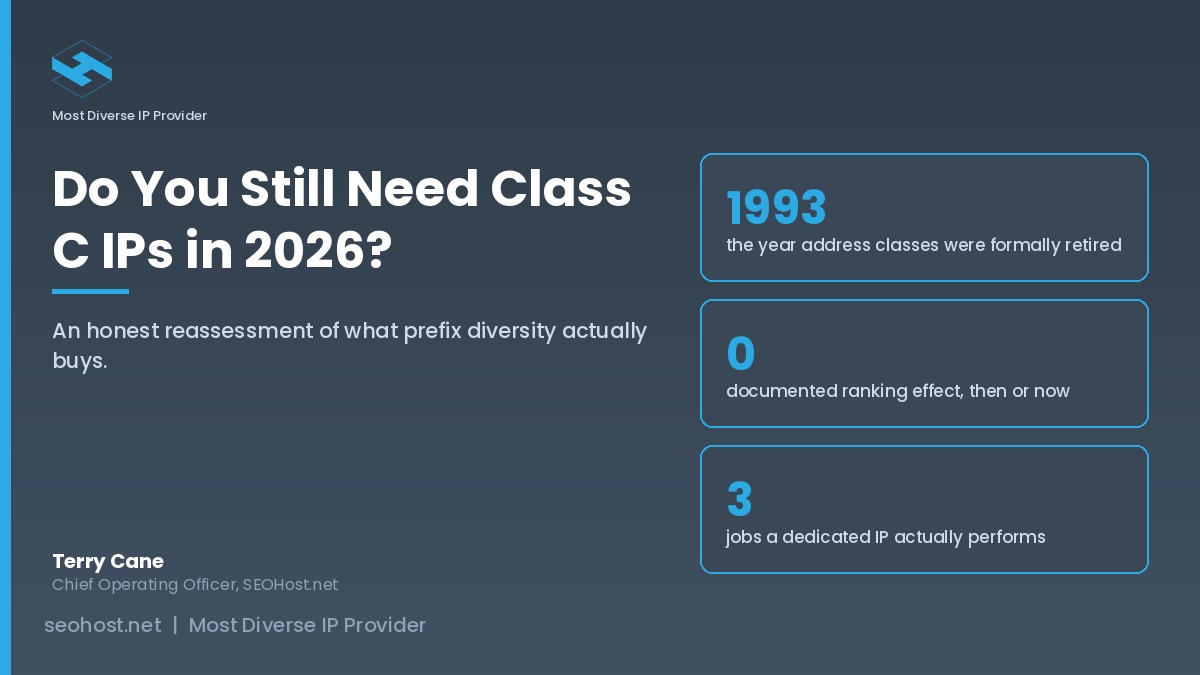
- What are the three jobs of a dedicated IP that SEOHost.net identifies?
- If I run 40 interlinked sites on one /24 prefix, does Class C IP SEO separation help?
- How does shared IP hosting compare to SEOHost.net's Class C IP SEO hosting for blocklist exposure?
- Does a dedicated IP address improve SEO rankings in Google?
- How many distinct /24 prefixes exist in the historic Class C address space?
- When should a 12-site network move from SEOHost.net shared Class C hosting to an SEO VPS?
- Do AI search engines like ChatGPT use Class C IP SEO signals in 2026?
Class C IP SEO is not a ranking factor and never was. In 2026 it remains a risk-management purchase: it contains reputation damage and protects reachability, which is what AI answer engines actually depend on.
Class C IP SEO is one of the last pieces of hosting folklore still sold at scale, and the honest answer to whether you need it in 2026 is more interesting than either side of the usual argument. Vendors say it lifts rankings. Skeptics say it does nothing. Both are wrong, and the reason they are wrong is that they are arguing about the same three letters while describing entirely different products.
Below is a reassessment written the way we would explain it to a customer on the phone: what the term actually means, what Google actually documents, what the separation genuinely does, and how the arrival of AI answer engines changed the value of one of those jobs without changing the others at all.
Class C IP SEO in 2026: The Short Answer
Specifically, dedicated Class C addressing does not raise rankings, has never been shown to raise rankings, and no 2026 development changed that. Anyone selling it as a ranking multiplier is selling a story.
However, that is not the same as saying the purchase is worthless. Separation across distinct prefixes does three concrete things, none of which is ranking. It limits how far a single abuse event can spread across a portfolio. It gives you an address reputation you control rather than inherit. Furthermore, it protects the plain ability of a crawler or an answer engine to fetch your page, which is the precondition for every ranking and every citation you might earn.
Therefore, the correct question is not whether Class C IP SEO works. The correct question is whether your setup activates any of those three jobs. For a single business website, it usually activates none of them and the money is better spent elsewhere. For a portfolio of thirty interlinked properties that also sends email, it activates all three.
What a “Class C IP” Actually Is (And Why the Term Retired in 1993)
Notably, the vocabulary the entire industry uses to sell this product was formally abandoned by the people who invented it more than thirty years ago. Understanding why is not pedantry — it reframes what you are buying.
Classless Routing Replaced Address Classes
Originally, IPv4 addresses were carved into fixed classes at octet boundaries. Class A took the first octet, Class B the first two, Class C the first three. Consequently, a “Class C network” meant a block of 256 addresses sharing the same first three octets.
However, that scheme did not survive contact with the growing internet. Classless Inter-Domain Routing replaced it, and RFC 4632, the current Best Current Practice document for CIDR, discusses the class A/B/C system entirely in the past tense as a problem that needed solving. Address classes have not described how the internet routes traffic since the 1990s.
Accordingly, when a host advertises a “Class C IP,” no router anywhere agrees with that description. The term persists purely as market vocabulary in one small corner of the hosting industry, which is worth knowing before you evaluate any claim built on top of it.
What You Are Really Buying Is a /24 Prefix
In practice, the product being sold is a /24 prefix: an address block where the first 24 bits are fixed and the last 8 vary. That is the same “first three octets match” idea, expressed in the notation networks actually use.
Furthermore, once you write it that way the arithmetic becomes checkable, and the arithmetic is genuinely surprising. The full IPv4 space contains 16,777,216 distinct /24 prefixes. The historic Class C range alone — first octets 192 through 223 — contains 2,097,152 of them. Meanwhile, the largest commercial diverse-IP pools on the market, including our own 1,300-plus distinct ranges, amount to roughly six hundredths of one percent of that historic space.
Consequently, the “look statistically unique to a crawler” argument collapses on inspection. With two million prefixes in play, any two randomly chosen hosting accounts already sit in different ones. Distinctiveness was never scarce. What is scarce — and what you are genuinely paying for — is knowing and controlling who else shares your specific prefix. That distinction is the whole reassessment in one sentence.
The Class C IP SEO Ranking Claim: What Google Actually Documents
Specifically, Google’s own documentation treats moving your site between hosting providers, IP addresses, or CDNs as a routine migration rather than a ranking event. The Search Central guide to changing hosting infrastructure is written entirely around operational continuity: update DNS, watch server logs, keep verification working. Nowhere does it describe an address as a quality signal.
Moreover, the practical evidence points the same direction. Shared addressing is the default condition of the hosted web. Content delivery networks place thousands of unrelated businesses behind the same address ranges as a matter of design. Therefore, an address-based penalty would sweep up an enormous volume of ordinary sites for no useful gain, which is why no search engine has ever documented one.
Notably, that same Google guide does contain one instruction that matters enormously for the rest of this article, and it has nothing to do with rankings: check that your firewall or denial-of-service protection does not block a crawler’s ability to reach your servers. Google’s stated concern about your infrastructure is access, not allocation. Hold onto that.
In other words, the reassessment does not end with “Class C IP SEO does not work.” It ends with a corrected understanding of what the product was always doing.
Job One — Footprint Separation: Class C IP SEO’s Original Purpose
Historically, prefix diversity was bought so that a network of interlinked properties would not present one obvious shared-infrastructure fingerprint. That was the original job, and it is worth being precise about how much of it survives.
Firstly, the honest limitation. Separation does not make a manipulative link pattern acceptable. Google’s spam policies define link schemes by the behavior — buying, exchanging, or building links at scale to pass ranking credit — and those definitions say nothing about addressing. Consequently, a link scheme spread across forty prefixes is still a link scheme. Any vendor implying that IP diversity confers compliance is describing a product that does not exist.
Secondly, the part that does survive. Separation limits blast radius. When one property in a portfolio attracts an abuse complaint, a malware compromise, or a hosting suspension, the question that determines your exposure is how much else lives at the same address. Furthermore, that is an operational risk with an operational answer, and it is entirely independent of whether search engines look at IPs at all.
Ultimately, Job One is real but conditional. It applies to portfolio operators and to nobody else. If you run one site, this job is inert, and our breakdown of which hosting model your project actually needs works through where the boundary sits.
Job Two — Neighbor Risk and Reputation Containment
Notably, this is the job most buyers underrate, and it is the one with the clearest published mechanism. Address reputation is real, it is tracked by third parties, and it propagates at range granularity rather than one address at a time.
Specifically, the Spamhaus Blocklist lists both individual addresses and address ranges, and its published listing criteria include patterns rather than single events — snowshoe configurations across ranges, and providers that decline to disconnect abusive customers. Additionally, the Combined Spam Sources dataset alone typically carries between two and four million listings at any moment.
Therefore, the practical exposure on a shared address is straightforward: your deliverability, and sometimes your reachability, is set by the worst-behaved account sharing it. You did not choose those neighbors, you cannot see them, and you cannot remove them. By contrast, a dedicated prefix makes that reputation yours alone — which is a smaller promise than “better rankings” and a far more defensible one.
Fortunately, this job is also easy to test. If your sites send transactional or marketing email, Job Two is active for you today, regardless of what you believe about search engines.
Job Three — Reachability: What Changed for Class C IP SEO in the AI Era
Above all, this is the job that changed value in 2026, and the change is subtler than the marketing suggests. No answer engine reads your IP allocation. There is no evidence that any large language model weighs prefix diversity, and we would be inventing a mechanism if we claimed otherwise.
Instead, what changed is the cost of being unreachable. Traditional crawlers queue, retry, and come back tomorrow. Answer engines increasingly fetch at the moment a person asks. OpenAI, for example, documents three separate user agents with distinct jobs — one for training, one for search indexing, and one that retrieves pages live in response to a user’s question — and publishes the address ranges each operates from.
Consequently, a fetch that fails does not get retried into a citation. It simply produces an answer built from somebody else’s page. Meanwhile, the most common cause of those failed fetches is not a robots.txt rule at all — it is bot management, rate limiting, and reputation-driven filtering sitting between the crawler and your server, exactly the layer Google’s own migration guide warns you to check.
Accordingly, the AI-era case for dedicated addressing is an availability case, not a ranking case. You are not buying a signal. You are buying a smaller chance that somebody else’s behavior makes your page unfetchable at the exact moment an answer engine goes looking for it. Our earlier analysis of how diverse IP networks build AI authority takes the visibility side of that argument further.
The Class C Reassessment Matrix (2026)
Specifically, here is every common claim about Class C addressing, scored against what can actually be documented. Notably, two of the five are false, one is obsolete terminology, and two are real but conditional.
| Claim | Verdict | Mechanism | Evidence class |
|---|---|---|---|
| “Class C IPs improve rankings” | Never true | No documented address-based ranking input | Search engine documentation |
| “Class C” describes real addressing | Obsolete | Address classes retired by classless routing | IETF Best Current Practice |
| “Diversity makes a link network safe” | False | Spam policies judge link behavior, not addresses | Search engine documentation |
| “Separation limits abuse blast radius” | Still true | One address, one shared fate for everything on it | Operational / provider policy |
| “Address reputation is inherited” | Still true | Blocklists list individual addresses and ranges | Reputation-service listing criteria |
Therefore, read the matrix as a spending guide. The two “still true” rows are the only ones you can responsibly buy against, and both of them describe containment rather than promotion.
Class C IP SEO vs Dedicated IP vs Shared IP: Which Risk Are You Buying Down?
In practice, the three options are not a quality ladder. Instead, each one buys down a different risk, and paying for a risk you do not carry is the most common mistake in this market.
| Setup | Neighbor exposure | Blast radius | Ranking effect | Fits |
|---|---|---|---|---|
| Shared IP | Inherited from strangers | Everything on the address | None | One low-risk site, no email |
| Single dedicated IP | Yours alone | Your site only | None | One business site that sends email |
| Multiple /24 prefixes | Yours alone, per prefix | One prefix at a time | None | Portfolios of interlinked properties |
Notably, the ranking column is identical across all three rows, and that is the point. Furthermore, once ranking is off the table, the decision becomes an ordinary infrastructure question with an ordinary infrastructure answer. Our full breakdown of what each tier actually costs per IP prices every option against a real address count.
Class C Reality Check
Accordingly, the checker below tells you which of the three jobs your setup activates, and therefore whether prefix diversity is worth paying for.
Class C Reality Check
Five questions. Which of the three jobs applies to you?
When Class C IP Diversity Is Still Worth Paying For
Ultimately, the reassessment produces a short and unglamorous buying rule. Prefix diversity is worth paying for when at least two of the three jobs are active, and it is worth skipping when none of them is.
- You operate a portfolio rather than a single site, and those properties reference each other.
- The domains send transactional or marketing email, which makes address reputation a live commercial exposure.
- You have already been burned once by a block, a suspension, or a deliverability collapse you did not cause.
- Losing one property to an abuse action must not be allowed to take the other twenty-nine with it.
- You need to see and control which address each domain sits on, rather than trusting a provider’s opaque pool.
Conversely, skip it if you run one website, send no email, and have never had an infrastructure incident. Furthermore, no amount of prefix diversity will improve that site’s position, and the budget is better spent on content and performance.
Match the Tier to the Constraint, Not the Address Count
Specifically, when the jobs do apply, the tier follows from the constraint rather than the address count. Entry-level portfolios sit comfortably on dedicated Class C IP hosting in the USA, geo-targeted campaigns run on European Class C IP hosting, maximum separation across distinct first-octet ranges comes from multiple Class A IP hosting, and root-level or resource-bound workloads move to an SEO VPS or a dedicated SEO server.
Finally, a note on where the ground is still moving. Answer engines are changing how retrieval works faster than any of us can publish about it, and our coverage of how AI Mode reshaped the hosting decision tracks that shift. Notably, none of it has produced an address-based ranking signal, and we will say so plainly on the day it does.
Frequently Asked Questions About Class C IP SEO
Does Class C IP SEO still work as a ranking tactic in 2026?
Specifically, no. Class C IP SEO has never been a documented ranking factor, and nothing in 2026 changed that. Google treats a change of host or IP address as routine infrastructure work rather than a ranking event. What separation still buys you is risk containment, which the Class C Reassessment Matrix scores claim by claim.
Class C IP SEO versus a single dedicated IP: which actually reduces risk?
Notably, a single dedicated IP removes your exposure to neighbors on that one address, while Class C IP SEO spreads sites across separate /24 prefixes so no single reputation event reaches all of them. In practice, one dedicated IP handles a single business site, and prefix spread only earns its cost once you operate a portfolio.
Is the phrase Class C IP still technically accurate in 2026?
Interestingly, it is not. Address classes were retired by classless routing, and RFC 4632 discusses the class A/B/C system purely as history. Consequently, what the industry sells as a Class C IP is a /24 prefix. The term survives as market vocabulary, not as networking.
What are the three jobs of a dedicated IP that SEOHost.net identifies?
Specifically, the three jobs are footprint separation, reputation containment, and reachability. Notably, ranking is not among them. Each job has a different trigger, and the decision checker in this guide tells you which ones your setup actually activates.
If I run 40 interlinked sites on one /24 prefix, does Class C IP SEO separation help?
Typically, yes, but not for the reason most buyers assume. Furthermore, separation reduces the blast radius when one property triggers an abuse action, and it does nothing to make an interlinking scheme compliant. Google’s spam policies judge the link pattern itself, not the addresses underneath it.
How does shared IP hosting compare to SEOHost.net’s Class C IP SEO hosting for blocklist exposure?
By contrast, shared IP hosting places your site behind an address whose reputation is set by everyone else on it. Spamhaus lists both individual addresses and ranges, so one persistent abuser can pull a whole block down with them. Dedicated prefixes make that exposure yours alone to manage.
Does a dedicated IP address improve SEO rankings in Google?
Specifically, no. A dedicated IP address does not improve rankings in Google Search, and Google documents host and IP changes as routine migrations. However, a dedicated address does protect the reachability that every ranking and citation depends on, which is a different and much more defensible claim.
How many distinct /24 prefixes exist in the historic Class C address space?
Specifically, the historic Class C range spans first octets 192 through 223, which contains 2,097,152 distinct /24 prefixes. Additionally, the full IPv4 space contains 16,777,216 of them. Therefore, even the largest commercial pool represents a fraction of one percent, which is exactly why distinctiveness was never the scarce resource.
When should a 12-site network move from SEOHost.net shared Class C hosting to an SEO VPS?
Typically, the trigger is resources rather than addresses. Furthermore, a 12-site network moves to an SEO VPS when the per-IP storage and bandwidth envelope on shared hosting stops fitting the sites, or when root access and non-WordPress applications enter the picture. Our per-tier cost breakdown works the crossover through in detail.
Do AI search engines like ChatGPT use Class C IP SEO signals in 2026?
Notably, there is no evidence that any answer engine weighs IP allocation. However, AI systems fetch pages live at answer time through documented crawlers, so a page that cannot be reached is a page that cannot be cited. Consequently, addressing matters to AI search through availability, never through allocation.