SEO Hosting Blog
-

SEO Hosting vs Multiple Hosts: What Spreading Your Sites Really Costs
TL;DRSpreading a network across multiple hosts separates the IP address and the server, and Google has said neither one sets your rankings. Most of the other things that connect your sites, from the registrar record to the analytics ID, move with you to every host. What multiple hosts really adds is admin: a login, a renewal and a PHP schedule per site. For three sites that is a fair trade. Past that, we think one SEO host with separate addresses and nameservers per site is the better one, and the calculator below lets you test that against your own numbers.
-
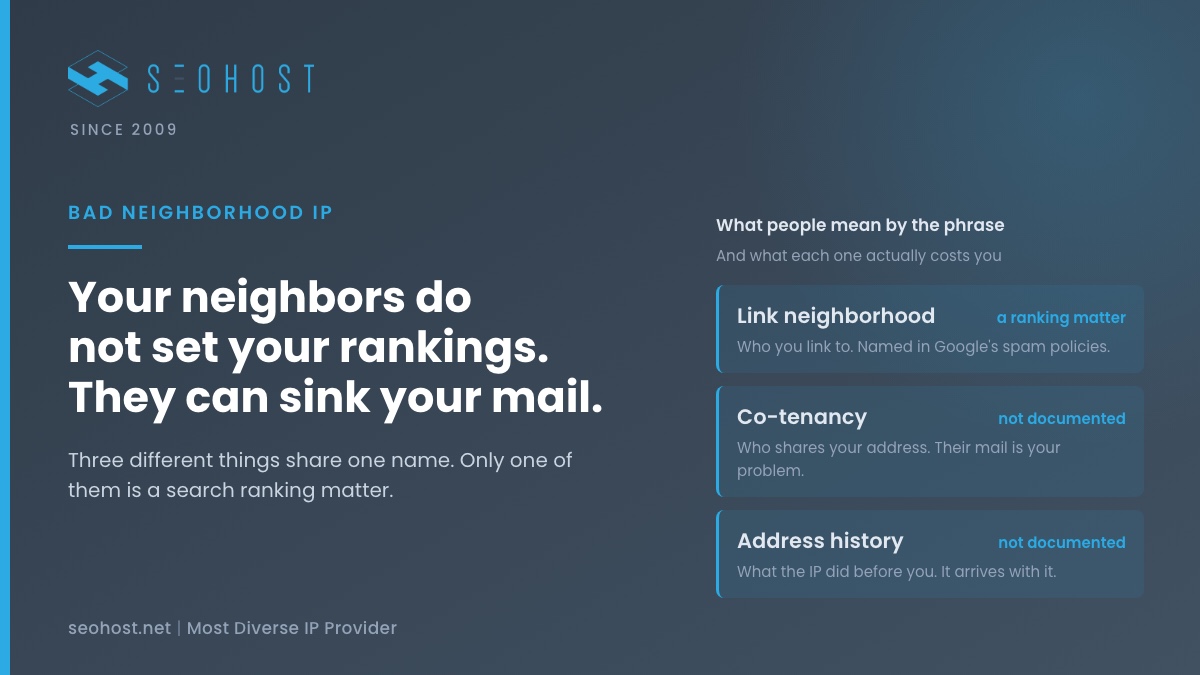
Bad Neighborhood IPs: What Sharing an IP With Spam Sites Actually Costs You
TL;DRA bad neighborhood IP is mostly not a ranking problem: Google’s spam policies describe links and behavior, not addresses. What an address’s history really costs you is rejected mail, challenged traffic and a cleanup you run yourself. We scanned the 512 addresses around our own site against two blocklists to show what a real neighborhood looks like, and how to check yours in five minutes.
Categories
- AI SEO
- Blogging
- International SEO
- Marketing
- News
- Search Engine Optimization
- SEO
- Web Hosting
- Webmaster
Social Links!
-

Should You Consider Targeting Keywords With a Low Monthly Volume?
This story should be familiar to most of you. You’ve come up with an excellent idea for content—something you’re confident will resonate with your audience and bring in qualified leads. However, when it comes time to start researching keyword permutations for that topic, you’re met with a rather unpleasant surprise. No matter how you phrase…
-

Brain Engine Optimization is More than Just a Buzzword
If there’s one thing the marketing profession loves, it’s buzzwords. And by all accounts, Brain Engine Optimization (or BEO, for short) appears to fit the bill. No, it doesn’t have anything to do with Google’s RankBrain Algorithm (even though by all accounts one would expect it to). As noted by Marketing Week, it’s a phrase…
-

Is It Ever Worthwhile to Optimize for Search Engines Other Than Google?
There’s no question that Google dominates the world of search. Its algorithms handle roughly 90% of all search queries worldwide. Its closest rival, Bing, has a market share of a paltry 3.33%; the next runner-up, Yahoo, clocks in at 1.34%. With the above in mind, it’s hardly a surprise that the majority of search engine…