- Why People Spread Their Sites Across Multiple Hosts
- What Google Has Said About Hosting, IPs and Neighbors
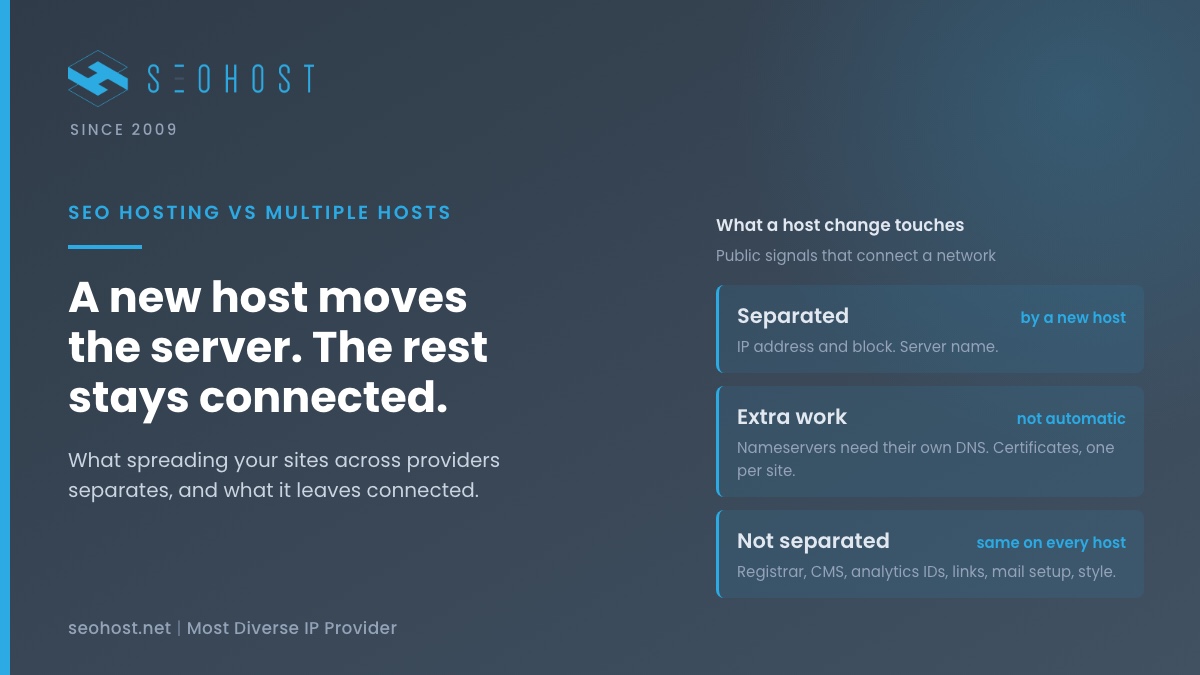
- What Multiple Hosts Does Not Separate
- The Real Cost of Multiple Hosts Is Not the Bill
- Pricing Multiple Hosts Honestly: Run the Numbers Yourself
- What One SEO Host Replaces, and What It Cannot Hide
- SEO Hosting vs Multiple Hosts: A Decision Rule by Network Size
- Frequently Asked Questions About SEO Hosting vs Multiple Hosts
- Is spreading your sites across multiple hosts still worth it for SEO in 2026?
- Does Google rank a site differently on shared hosting than on dedicated hosting?
- SEO hosting vs multiple hosts: which one is cheaper for a 14-site network?
- Which footprints still connect my sites when they sit on multiple hosts?
- Separate nameservers vs separate hosts: which one does more to split a network?
- How many sites can you run on multiple hosts before the admin outweighs the savings in 2026?
- Does SEOHost.net give each site its own Class C IP and nameservers?
- Can I split one network between two SEOHost.net accounts or locations?
- Does SEOHost.net check an IP address's reputation before issuing it in 2026?
- Will moving my sites from multiple hosts to one SEO host affect my rankings?
Spreading a network across multiple hosts separates the IP address and the server, and Google has said neither one sets your rankings. Most of the other things that connect your sites, from the registrar record to the analytics ID, move with you to every host. What multiple hosts really adds is admin: a login, a renewal and a PHP schedule per site. For three sites that is a fair trade. Past that, we think one SEO host with separate addresses and nameservers per site is the better one, and the calculator below lets you test that against your own numbers.
Anyone pricing SEO hosting for the first time runs into the same objection, usually from a forum thread: why pay for it at all, when you could buy a cheap plan at each of multiple hosts and get a different address for every site? It sounds like the frugal, safe answer. Each site on its own provider, nothing in common, no single company holding the whole network.
This post prices that idea properly, on both of its costs. One is the bill, which you can only add up from your own quotes, and we show you how. The other is everything the bill leaves out: the records that still connect your sites on any host, and the admin that grows with every provider you add. We sell the other option, so we have tried to be fair to this one, including where it wins. By Terry Cane, Chief Operating Officer, SEOHost.net.
Why People Spread Their Sites Across Multiple Hosts
The case is not foolish, and it deserves to be stated at its strongest before anyone argues with it. People who split a network across providers usually want one or more of four things.
First, a different IP address and server for every site, without paying a specialist for them. Second, containment: if one provider has an outage, suspends an account or gets bought and changes its terms, only one site feels it. Third, privacy, because no single company sees the whole portfolio. Fourth, a low entry price, since a basic shared plan for one site is about the cheapest thing in hosting.
All four are real. The question is what each one costs to get this way, and whether it is the thing that actually protects the network.
When Multiple Hosts Is Genuinely the Right Call
For two or three sites that you keep current, multiple hosts works well. The admin is small, the containment is genuine, and nothing in this post should talk you out of it. The same goes for sites that belong to different businesses or different owners, which should never share an account in the first place.
One boundary is worth stating plainly. If a network exists to pass links that manipulate rankings, Google’s policy applies to the links, not to where they are hosted, and no arrangement of providers changes that. The rest of this post is about separation for containment, privacy and operations, which are good reasons on any network.
What Google Has Said About Hosting, IPs and Neighbors
Three documents settle most of the ranking question. The first is a direct statement. In a 2021 report of John Mueller’s comments, Google’s search advocate said shared hosting does not negatively affect a site in Google Search, and that “We treat each website based on its own merits not based on its virtual neighbors.”
The second is Google’s spam policies for web search, which define link spam as “creating links to or from a site primarily for the purpose of manipulating search rankings.” That definition is about links. Nothing on the page describes a hosting arrangement as a signal in either direction.
The third is the guide to changing your web hosting, which treats switching providers with unchanged URLs as an infrastructure change and warns only of a temporary drop in crawl rate afterward. Taken together, a host is plumbing to Google. A different host does not buy a ranking, and the same host does not cost one. Our honest reassessment of Class C IPs reaches the same conclusion from the address side.
What Multiple Hosts Does Not Separate
If the goal is a network whose sites cannot be tied together at a glance, the useful question is which records connect them, and which of those a host change actually touches. We listed the ten public signals we see connect sites most often, and checked each against a move to a different provider.
| Signal | Where anyone can see it | Does a different host separate it? |
|---|---|---|
| IP address and its block | DNS lookup | Yes |
| Server name (reverse DNS) | Reverse lookup on the IP | Yes |
| Nameservers | DNS and the registration record | Only if you also change DNS provider |
| TLS certificates | Public certificate logs | Only if every site has its own certificate |
| Registrar and creation date | Registration data lookup | No |
| CMS, theme and plugin set | Page source | No |
| Analytics, tag and ad IDs | Page source | No |
| Links between the sites | Any crawler | No |
| Mail setup (SPF includes, sending service) | DNS TXT records | No |
| Who writes it: author names, contact page, style | The pages themselves | No |
Reading the Carry-Over Map
Two signals separate automatically, two separate only with extra work, and six of the ten stay exactly where they were. They follow the domain, the code and the person, and all three come with you to every provider.
Registration data is the clearest example. ICANN’s Registration Data Policy requires the registrar, the creation date, the expiry date and the domain status to be published for every domain, while the registrant’s name is redacted. Ten domains registered at one registrar on one afternoon read that way in ICANN’s own lookup tool, whatever servers they point at.
Certificates are the other one people miss. Certificate Transparency logs are public, so every name on a certificate is listed for anyone to search. One certificate that covers several of your domains connects them permanently, on any host. Our note on why a CDN is not IP diversity walks through the same records from the proxy side.
The Real Cost of Multiple Hosts Is Not the Bill
Price comparisons between the two approaches usually stop at the monthly invoice, and that is where they go wrong. The invoice is the part of the cost that stays flat per site. What grows with every provider you add is the number of separate things you have to keep working.
To make that concrete we used a 14-site network, because 14 is the median number of IPs on an active SEOHost.net account: half our 88 active IP accounts hold that many or fewer (as of 28 August 2026). In other words, it is an ordinary network rather than a large one.
| What you have to keep working | Fourteen sites on multiple hosts | Fourteen sites on one SEO host |
|---|---|---|
| Control panels and logins | Up to 14 | 1 |
| Renewal dates and invoices | Up to 14 | 1 |
| Payment methods on file | Up to 14 | 1 |
| PHP upgrade schedules set by someone else | Up to 14 | 1 |
| Backup systems to test-restore | Up to 14 | 1 |
| Support desks to learn | Up to 14 | 1 |
| Sites one outage or suspension can reach | 1 | All 14, unless you split the account |
The last row is the honest one, and it cuts the other way. One account concentrates risk, which is the strongest argument multiple hosts has. We come back to how to answer it without thirteen extra logins.
One Line Item Makes the Point: PHP Versions
PHP shows how the admin compounds. According to the PHP project’s support schedule, each release branch gets two years of active support and two more of security fixes only, after which it reaches end of life. Security support for PHP 8.2 ends on 31 December 2026.
Across multiple hosts, each provider retires old versions on its own timetable, announces it its own way, and lets you switch through its own panel. Fourteen sites means fourteen notices to catch and fourteen upgrades to test. Miss one and that site runs unpatched code. The same pattern repeats for backups, certificates and every other recurring job.
Pricing Multiple Hosts Honestly: Run the Numbers Yourself
We are not going to quote other providers’ prices. They change, they vary by promotion, and the only source for them is the providers themselves. What we can give you is the list of lines a fair comparison has to include, and a calculator to add them up.
For each plan, use the renewal price, not the first-term price, because you pay the renewal every year after the first. Add any certificate, backup or dedicated address the plan charges extra for. Then put a figure on your own time, because the logins and upgrades above are paid for in hours. Our transparent pricing breakdown lays out the SEO hosting side of the comparison line by line.
Count the Cost of Multiple Hosts
Pick a network size, then enter your own figures. Nothing is pre-filled, and nothing leaves your browser.
What One SEO Host Replaces, and What It Cannot Hide
Of the ten signals on the map, a good SEO host can separate the first four from a single account: a different IP address per site, a server name that is not shared, a private ns1 and ns2 per domain, and a separate certificate per site. Multiple hosts gives you the first two, and the second two only if you do the extra work for each provider.
The other six are not a hosting matter, and any host that claims to hide them is overselling. Your registrar record, your theme, your analytics ID, your links, your mail setup and your writing are yours to vary on any server. Vary them because it is good practice, not because a provider promised to.
Answering the Concentration Risk Without Thirteen Extra Logins
The best argument for multiple hosts is that one account is one point of failure. The answer is to split the network into two or three accounts or locations, not fourteen, which keeps most of the containment and very little of the admin.
Some of our customers already work this way. As of 28 August 2026, 8 of 56 clients holding IP accounts with us run two or more separate accounts rather than one bigger estate. A split across continents goes further, since our USA and European addresses come from different pools. The median active account has also been with us for 4.9 years, which says something about how often people need to move once the setup is right.
SEO Hosting vs Multiple Hosts: A Decision Rule by Network Size
Here is the rule we would give a friend. It is a judgment from running hosting, not a measured threshold, so weigh it against your own hours from the calculator.
| Your network | What we would do | Why |
|---|---|---|
| 1 to 3 sites, no mail sent from them | Multiple hosts, or one ordinary plan | Admin is small, and nothing needs a dedicated address |
| 1 to 3 sites that send mail | A dedicated address per site, on either approach | A shared address shares its mail reputation |
| 4 to 10 sites | One SEO host, optionally split into two accounts | Logins and PHP upgrades start to slip |
| More than 10 sites | One SEO host split by location, or an SEO VPS | The admin grows with every provider; the separation does not |
The mail row deserves its own link. Our guide to what a bad neighborhood IP actually costs explains why a shared address hurts mail long before it could touch rankings, and our comparison of SEO hosting and PBN hosting covers which product suits which kind of network.
What SEOHost.net Plans Include for This
This is what our USA Class C SEO hosting is built to do from one account: a dedicated Class C address per site from non-consecutive blocks, private ns1 and ns2 per domain, free SSL issued on each site, and the IP Manager tool inside WHM to assign and swap addresses. We check an address's reputation before issuing it, and if you find one listed, we swap it free.
For the split described above, EU Class C plans run on the same terms from a separate pool, Class A IP hosting in the USA varies the first octet as well, and an SEO VPS suits the largest networks. Migration is free, and every plan carries a 30-day money-back guarantee.
Frequently Asked Questions About SEO Hosting vs Multiple Hosts
Is spreading your sites across multiple hosts still worth it for SEO in 2026?
In practice, it is worth it for a small number of sites and rarely for the reason people expect. Google has said it treats each website on its own merits, so a different host does not lift rankings. What multiple hosts genuinely buys is separation from one provider's outage or suspension. Past a handful of sites, we think the admin it adds outweighs that separation.
Does Google rank a site differently on shared hosting than on dedicated hosting?
Typically not. In 2021 Google's John Mueller said that using shared hosting is perfectly fine and does not negatively affect a site in Google Search, and that Google treats each website based on its own merits, not its virtual neighbors. Speed and uptime still matter to visitors, but the type of hosting is not itself a ranking input.
SEO hosting vs multiple hosts: which one is cheaper for a 14-site network?
Specifically, it depends on the renewal price of every plan you would use, not the first-term price, so add up your own quotes rather than trusting a headline. Then add what the bill leaves out: fourteen logins, fourteen renewal dates and fourteen PHP schedules, priced at what your time is worth. The calculator in this post turns those into your own figure rather than ours.
Which footprints still connect my sites when they sit on multiple hosts?
Notably, most of the public ones. Registrar and creation date are published for every domain, the CMS, theme and analytics IDs sit in each page's source, and the links between the sites are visible to any crawler. A host change separates the IP address and the server name. Nameservers and certificates separate only if you change those as well.
Separate nameservers vs separate hosts: which one does more to split a network?
In fact, nameservers are often the bigger tell, because a network spread across ten hosts but managed through one DNS account shows the same nameserver pair on every domain. Separate hosts change the IP address; separate nameservers change a record anyone can read in seconds. A private ns1 and ns2 per domain does both jobs from a single account.
How many sites can you run on multiple hosts before the admin outweighs the savings in 2026?
Overall, our working rule is about three. Up to three sites, separate hosts are easy to keep current and the separation is real. From four to ten the logins, renewals and PHP upgrades start to slip, and above ten, keeping every site current becomes a job of its own. That is a judgment from running hosting rather than a measured threshold, so test it against your own hours.
Does SEOHost.net give each site its own Class C IP and nameservers?
In particular, every plan does this. Each site you assign an address to gets a dedicated Class C IP from non-consecutive blocks, its own private ns1 and ns2, and its own free SSL certificate. The IP Manager tool inside WHM assigns and swaps addresses per site, so the separation multiple hosts would give you is handled from one control panel.
Can I split one network between two SEOHost.net accounts or locations?
Indeed, and some customers already do. As of 28 August 2026, 8 of 56 clients holding IP accounts with us run two or more separate accounts rather than one larger one. Placing part of a network on USA addresses and part on European addresses also puts the halves in different pools on different continents, which keeps one account from carrying everything.
Does SEOHost.net check an IP address's reputation before issuing it in 2026?
Fortunately, yes. We check an address's reputation before it is assigned to a new account. If you still find an address you were issued on a blocklist, tell us and we will swap it free of charge. You can also run the five-minute blocklist check from our bad neighborhood guide on any address before you build on it.
Will moving my sites from multiple hosts to one SEO host affect my rankings?
Ultimately, not if the URLs stay the same. Google treats a change of hosting provider with unchanged URLs as an infrastructure move, and says a temporary drop in Googlebot's crawl rate right after the move is normal, followed by a steady increase over the next few days. Migration onto SEOHost.net is free, and moving one site at a time keeps any wobble small.