SEO Hosting Blog
-

SEO Hosting vs Multiple Hosts: What Spreading Your Sites Really Costs
TL;DRSpreading a network across multiple hosts separates the IP address and the server, and Google has said neither one sets your rankings. Most of the other things that connect your sites, from the registrar record to the analytics ID, move with you to every host. What multiple hosts really adds is admin: a login, a renewal and a PHP schedule per site. For three sites that is a fair trade. Past that, we think one SEO host with separate addresses and nameservers per site is the better one, and the calculator below lets you test that against your own numbers.
-
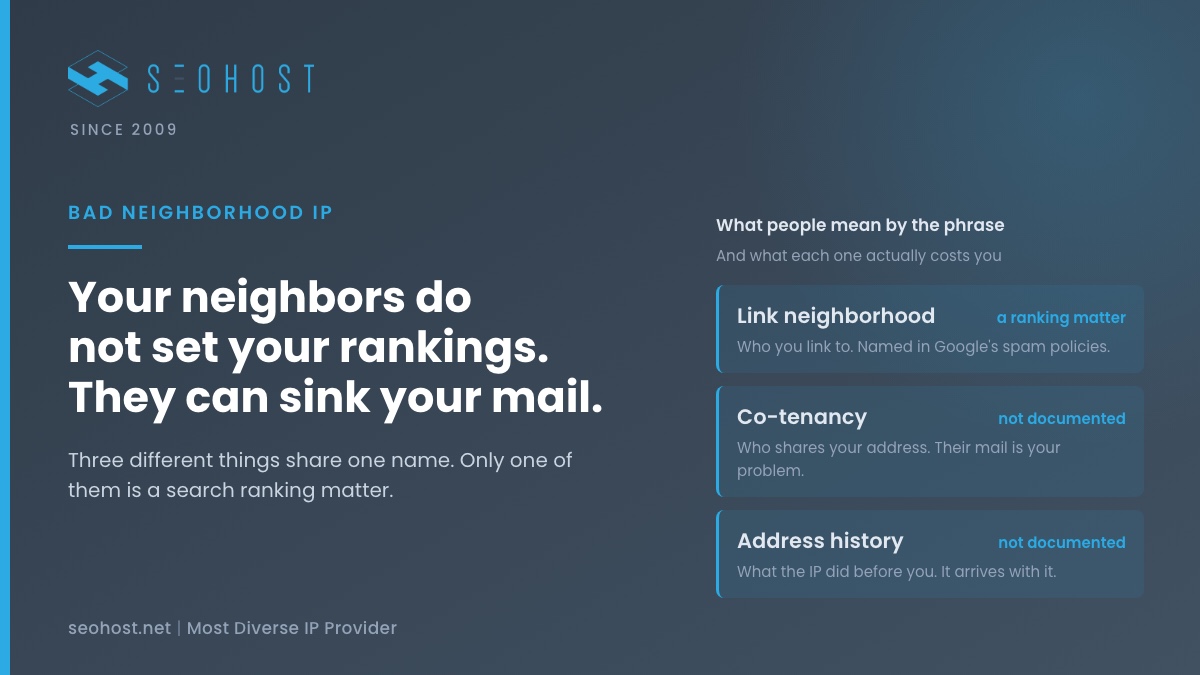
Bad Neighborhood IPs: What Sharing an IP With Spam Sites Actually Costs You
TL;DRA bad neighborhood IP is mostly not a ranking problem: Google’s spam policies describe links and behavior, not addresses. What an address’s history really costs you is rejected mail, challenged traffic and a cleanup you run yourself. We scanned the 512 addresses around our own site against two blocklists to show what a real neighborhood looks like, and how to check yours in five minutes.
Categories
- AI SEO
- Blogging
- International SEO
- Marketing
- News
- Search Engine Optimization
- SEO
- Web Hosting
- Webmaster
Social Links!
-

How Is the Robots.txt File Used for SEO?
The robots.txt file is an important part of search engine optimization (SEO) that can help improve your web pages’ visibility in search engines. This article will describe what the robots.txt file is, how it works and how you can use it to improve your site’s SEO. We’ll also look at some best practices and tips…
-
What’s Wrong with the YouTube Algorithm? According to Creators, a Great Deal
YouTube’s recommendation algorithm drives roughly 70 percent of what people watch on the video-hosting platform. That’s to be expected, of course, especially since parent company Alphabet also manages and maintains the world’s largest search engine. What you might not expect is that in spite of Google’s ubiquity in the world of search engine optimization, YouTube’s…
-
Here’s What You Need to Know About Google’s New “Double-E-A-T”
By now, it’s safe to say that most people are at least aware of Google’s quality rater guidelines—the metrics the company uses to assess its own algorithms internally. Although these metrics never directly influenced PageRank, Google’s system for ranking web pages, most people involved in the field of search engine optimization agree that understanding and…