- Does Google Penalize SEO Hosting? The Short Answer
- Does Google Penalize SEO Hosting or the Link Scheme Behind It?
- What We Counted in Google's Own Policy Pages
- What About the Study That Said Shared Hosting Ranks Worse?
- The Footprint Scorecard: Ten Signals and Who Can Fix Each
- What a Manual Action Looks Like for a Network
- What SEO Hosting Does and Does Not Buy
- Score Your Own Network Footprint
- A Practical Checklist: Before You Blame the Host
- Frequently Asked Questions: Does Google Penalize SEO Hosting?
- Does Google penalize SEO hosting in 2026 if each site has its own IP address?
- Does Google penalize SEO hosting or only the link schemes that people build on it?
- Does Google penalize SEO hosting that uses Class C IP addresses in 2026?
- Does Google penalize SEO hosting when sites share one nameserver pair, or only when they share an IP?
- Shared IP vs dedicated IP: which one does Google penalize in 2026?
- Does Google penalize SEO hosting vs regular hosting differently when the content is the same?
- Can SEOHost.net hosting trigger a Google manual action on my site in 2026?
- What did the Reboot Online shared hosting study actually prove about rankings?
- Does SEOHost.net give me anything that lowers the footprint risk on a network of sites?
- Is a link network on SEOHost.net protected from penalties if the content is thin?
No. Google does not penalize SEO hosting. Its published spam policies and manual actions name links, content and abuse of free services, and never a site on its own IP address. Hosting does not earn a bonus either. What it changes is how easily your sites can be grouped, so use separate addresses and nameservers to limit blast radius, and fix the non-technical footprints no host can touch.
Does Google Penalize SEO Hosting? The Short Answer
Does Google penalize SEO hosting? No. Putting a site on its own IP address, on its own nameservers, in its own account, is not a violation of anything Google publishes, and it is not a ranking input either. We sell SEO hosting, so you are right to doubt a sentence like that from us. The rest of this post therefore shows the work: what Google’s own pages say, what we counted in them, and where the real risk sits.
The honest version has two halves. Hosting on separate addresses carries no penalty, and it carries no bonus. What does attract penalties is a network built to pass links, and that judgment is about intent and content, not about which address answered the request. Google’s spam policies describe behaviors, and none of them is a hosting arrangement.
That distinction matters because it changes what you buy hosting for. If separate addresses cannot protect weak content, and cannot raise strong content, the only job left for them is limiting how many of your sites can be grouped by a trivial check. That job is real, and it is smaller than most sales pages claim. Our own knowledge base answer says the same in fewer words.
Does Google Penalize SEO Hosting or the Link Scheme Behind It?
Does Google penalize SEO hosting for running a network? Google penalizes the scheme. Its link spam policy defines the practice as creating links to or from a site primarily to manipulate search rankings, and lists the examples: buying or selling links, excessive link exchanges, automated link creation, and widely distributed links in the footers or templates of various sites. Every item is a behavior. None is a server setting.
A link farm shows why the two get confused. Wikipedia defines a link farm as a group of websites that all link to each other to raise rankings. A network of that kind often runs on many addresses, so people conclude the addresses were the offense. They were not. The same network on one address would be judged the same way, because the links and the content are what Google can read.
Why the confusion persists
Two opposite claims circulate. One says separate addresses protect a network, and the other says anything marketed as SEO hosting must be suspect. Both fail for one reason: neither is derived from a Google document. The word that does appear in Google’s materials is hosting, and the next section shows in what sense. So when someone asks does Google penalize SEO hosting, the useful reply starts with which document they mean.
What We Counted in Google’s Own Policy Pages
On November 18, 2026 we opened the two pages that govern this question and counted terms in the page text, navigation removed. The pages were the spam policies page (last updated August 28, 2026) and the Search Console manual actions report. You can repeat the count with a browser’s find-in-page in two minutes.
| Term | Spam policies page | Manual actions report | What the hits are about |
|---|---|---|---|
| IP address | 0 | 1 | Redirects shown only to a range of visitor IP addresses, a cloaking test |
| Nameserver, DNS | 0 | 0 | Not mentioned |
| Registrar, WHOIS | 0 | 0 | Not mentioned |
| Class C, C-block, footprint | 0 | 0 | Not mentioned |
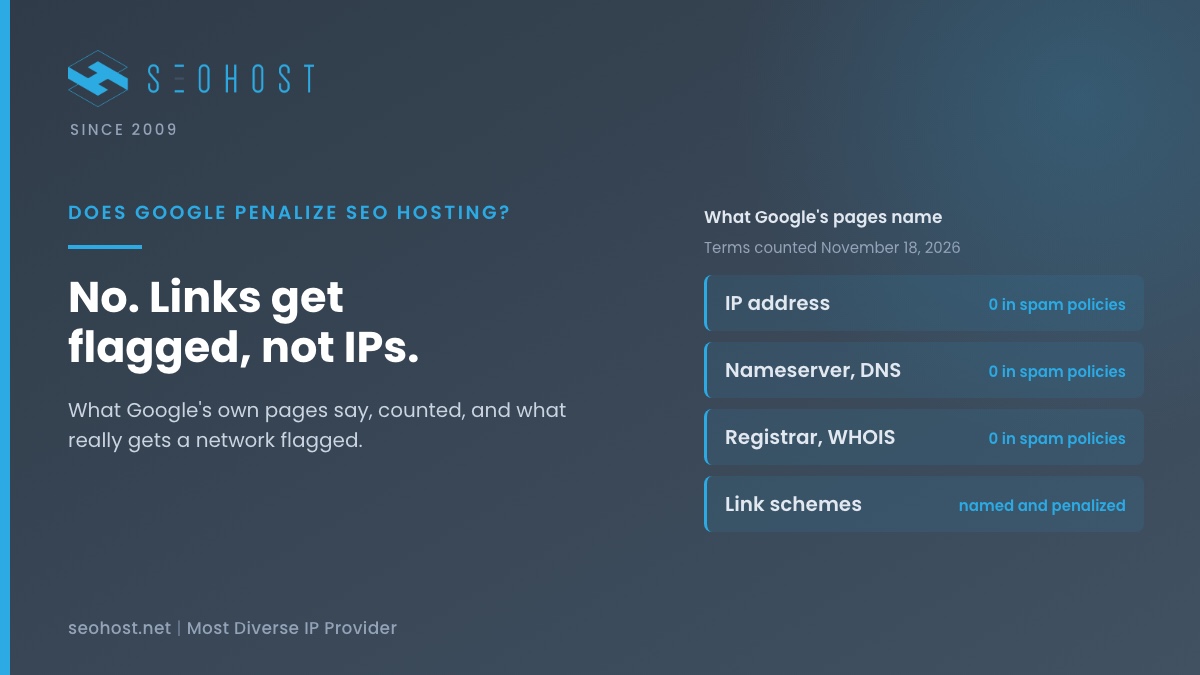
| Hosting | 8 | 5 | Hosting scraped or low-value content, spam accounts on free hosting services, and the Spammy free host action |
| Shared (as in shared hosting) | 0 | 0 | The one hit on the spam page concerns media shared without consent |
Read the last column before drawing a conclusion about whether the worry is fair. Does Google penalize SEO hosting on the evidence of this table? No. Every hit for hosting is about what is hosted, such as scraped pages or spam, or about free services that anyone can register on. The single IP address mention is about showing different pages to different visitors. Nothing describes an ordinary paid site on its own address, and that absence is the answer.
The one manual action that names a host
The manual actions report does include Spammy free host. It applies when a significant fraction of sites on a free web hosting service are spammy, and Google says it may then act on the whole service. The recipient is the service operator, and the example is a free host with open sign-up. A paid account with its own address and a vetted network is the opposite case.
What About the Study That Said Shared Hosting Ranks Worse?
The best-known counterargument is the Reboot Online experiment, and it deserves a straight reading. TechRadar reported in September 2020 that the team built twenty test sites on a made-up keyword, put half on cloud infrastructure and half on cheap shared hosting, tracked them for just over three months, and found the shared-address sites ranked less strongly.
Google’s John Mueller answered on Twitter that the method was flawed. He said he knows of no Google algorithm that takes the addresses of other sites on a server into account, and he pointed to Blogger, where sites share the same infrastructure and addresses yet some rank terribly and others do great. A later statement was blunter. In 2024 he wrote that “it’s normal for them to be shared” about the limited supply of addresses.
So does Google penalize SEO hosting on shared addresses, as that study implied? Not on this evidence. Twenty pages on one nonsense keyword for three months is a thin base for a rule about the web. We would not call it proof that shared addresses hurt. We would also not call Mueller’s answer a reason to ignore separation, because his point concerns ranking, and the reason to separate sites was never ranking. It is the next question.
The Footprint Scorecard: Ten Signals and Who Can Fix Each
A footprint is any signal saying that nominally independent sites are really one operation. Google does not publish a footprint rule, and we cannot show that any of these signals is a ranking input. They are the things a person or a script can read in minutes, which is why they matter when a reviewer or a competitor compares your domains.
| Signal | Visible through | Who can separate it |
|---|---|---|
| Every site on the same IP address | Public DNS lookup | Hosting: one address per site |
| Consecutive addresses in one block | Public DNS lookup | Hosting: non-consecutive addresses |
| One shared nameserver pair | NS record | Hosting: private nameservers per domain |
| Identical DNS zones | A, MX and TXT records | Hosting and you: a separate zone per site |
| One account holding every site | Control panel, mail headers | Hosting: separate accounts |
| Same theme and layout | Page source | Only you |
| Registered in one batch at one registrar | Registration records | Only you |
| One analytics or advertising ID | Page source | Only you |
| Uniform interlinking | Link graph | Only you |
| Thin or spun content | Reading the pages | Only you |
The split is five and five, and the two halves behave differently. Infrastructure signals disappear when you buy the right hosting, while the remaining five survive any hosting change, because they live in your templates, your registrar account and your link plan. Our comparison of SEO hosting and PBN hosting covers the hosting half in more depth.
What a Manual Action Looks Like for a Network
Does Google penalize SEO hosting through a manual action? Only the action list can tell you. A penalty that a person at Google applies shows up in Search Console under Manual actions, with a named reason and recommended steps. Algorithmic demotions do not appear there, which is why the report is the one place where Google tells you what it objects to. Four entries are relevant to site networks.
| Manual action | What Google says triggers it | Does paid hosting trigger it? |
|---|---|---|
| Unnatural links to your site | A pattern of unnatural, artificial or manipulative links pointing at the site | No, the links do |
| Unnatural links from your site | Paid or exchanged outbound links that pass ranking credit | No, the links do |
| Thin content with little or no added value | Low-quality pages with little original value | No, the pages do |
| Spammy free host | A large share of spammy sites on a free hosting service | Only for the free service operator |
The recovery path is the same in every case. Fix the violation, remove or qualify the links, then select Request Review. Notice what is absent: not one step asks you to change an IP address or a nameserver. If your content or links are the problem, no allocation of addresses fixes it, and Google’s own remediation steps say as much by never mentioning them.
What SEO Hosting Does and Does Not Buy
It buys blast radius. When sites share an address, a nameserver pair and an account, one suspension, one blocklist entry or one compromised site can reach all of them at once. Separate addresses make that damage local. That is a legitimate reason to buy, and the one we would put on a sales page, because it is true whatever Google does.
It does not buy invisibility. Certificates are public, for a start: Let’s Encrypt submits every certificate it issues to certificate transparency logs, so a hostname you secure is searchable by anyone. Mail records can name your origin, and a CDN hides only the web address, as we measured in our CDN test. A careful reviewer can still link sites through signals that no host controls.
What the plans include
On SEOHost.net, private ns1 and ns2 per domain, cPanel and WHM, free SSL and the IP Manager are part of the plan rate. The IP Manager lets you see and change which address each site uses, and our Class C explainer shows what the address classes separate. For a network that needs real isolation, start with the USA Class C plans or the European plans, and move to a VPS when resource limits say so.
Score Your Own Network Footprint
Does Google penalize SEO hosting that leaves the footprint untouched? There is no such rule, but the widget below turns the scorecard into a count. It cannot see your sites, so it asks you. The answer to the question people actually have, whether your network needs new infrastructure or new decisions, usually shows up in the split.
Score Your Own Network Footprint
Tick every statement that is true of your sites today. The count runs in your browser and nothing is sent anywhere.
Tick the statements that apply to see your result.
See the USA Class C plansA Practical Checklist: Before You Blame the Host
If a site lost rankings and you suspect its hosting, work through these in order. Most of the time the cause is in the first three.
- Open Search Console and check Manual actions. A named action tells you the reason, and none means no one at Google penalized the site.
- Read the pages as a stranger would. Thin or near-duplicate pages explain more drops than any address does.
- List every link you control between your sites, and ask whether an independent publisher would link that way.
- Check whether the site changed when it moved. A redirect error or a slow server shows up as a drop that looks like a penalty. Our five-minute bad neighborhood check covers the address side.
- Run the footprint scorecard above, and fix the decision half first, because it survives any hosting change.
- Only then consider changing hosting, and do it for isolation and reliability, not for a ranking bonus that Google says does not exist.
If the checklist ends at step six, separate addresses are a sound choice, and we would gladly host the result. If it ends earlier, you have saved yourself a migration. That is a better outcome than a sale made on a claim we cannot support.
Frequently Asked Questions: Does Google Penalize SEO Hosting?
Does Google penalize SEO hosting in 2026 if each site has its own IP address?
In practice, no. Google documents no penalty for hosting a site on its own address, and neither its spam policies nor its manual actions report treat an IP address as a violation. Penalties target link schemes, thin content and similar behavior. A dedicated address earns no bonus either, so it does not rank a site higher.
Does Google penalize SEO hosting or only the link schemes that people build on it?
Specifically, the link schemes. Google describes link spam as links created primarily to manipulate rankings, and its manual actions are named for links, content and abuse of free services. The hosting arrangement is never the stated reason. A network of honest sites on separate addresses is not a violation, and a link scheme on one shared address is.
Does Google penalize SEO hosting that uses Class C IP addresses in 2026?
Fortunately not. Class C addresses are ordinary infrastructure, and nothing Google publishes mentions address blocks as a ranking or penalty input. What Class C separation changes is who can see a shared address across your sites. It is a way to keep sites from being grouped by a trivial check, not a way to earn rankings.
Does Google penalize SEO hosting when sites share one nameserver pair, or only when they share an IP?
Specifically, neither is a documented penalty. Google names no nameserver rule, and the word does not appear in its spam policies. A shared pair is still a readable fingerprint for anyone comparing your domains, which is why private nameservers per domain are included on SEOHost.net plans even though Google does not score them.
Shared IP vs dedicated IP: which one does Google penalize in 2026?
In fact, neither one. Google has said repeatedly that sharing an address is normal, because the supply of addresses is limited, and that a unique address brings no ranking advantage. The real difference is blast radius. On a shared address you share a fate with strangers, and on your own address you share it only with the sites you chose.
Does Google penalize SEO hosting vs regular hosting differently when the content is the same?
Indeed, it does not tell them apart. Google evaluates pages, links and behavior, and it publishes no category called SEO hosting to treat differently. Two identical sites, one on a regular plan and one on an SEO plan, are judged by the same documents. The only thing that changes is how easy the sites are to group.
Can SEOHost.net hosting trigger a Google manual action on my site in 2026?
In practice, not by itself. A manual action is issued for a violation such as unnatural links or thin content, and the Search Console report names the violation. The only host-related action in Google documentation is Spammy free host, which concerns free services where a large share of accounts are spam, not paid plans with their own addresses.
What did the Reboot Online shared hosting study actually prove about rankings?
Ultimately, very little that applies to you. It tracked twenty test sites on a nonsense keyword for just over three months and reported weaker rankings on shared addresses. A Google analyst answered that the method was flawed and that he knew of no algorithm using the addresses of other sites on a server. Twenty sites on one keyword is a thin base.
Does SEOHost.net give me anything that lowers the footprint risk on a network of sites?
Notably, yes, on the technical half. Each plan includes private ns1 and ns2 per domain, a different address per site chosen in the IP Manager, cPanel and WHM, and free SSL. Those remove the address and nameserver fingerprints. They do not touch theme, registrar, analytics ID or interlinking, which stay your decision.
Is a link network on SEOHost.net protected from penalties if the content is thin?
Typically not, because infrastructure only lets Google judge each site on its own, and thin pages then fail on their own merits. Google lists thin content with little or no added value as a manual action. We would rather tell you that plainly than sell separate addresses as protection for pages that would not survive being read.